

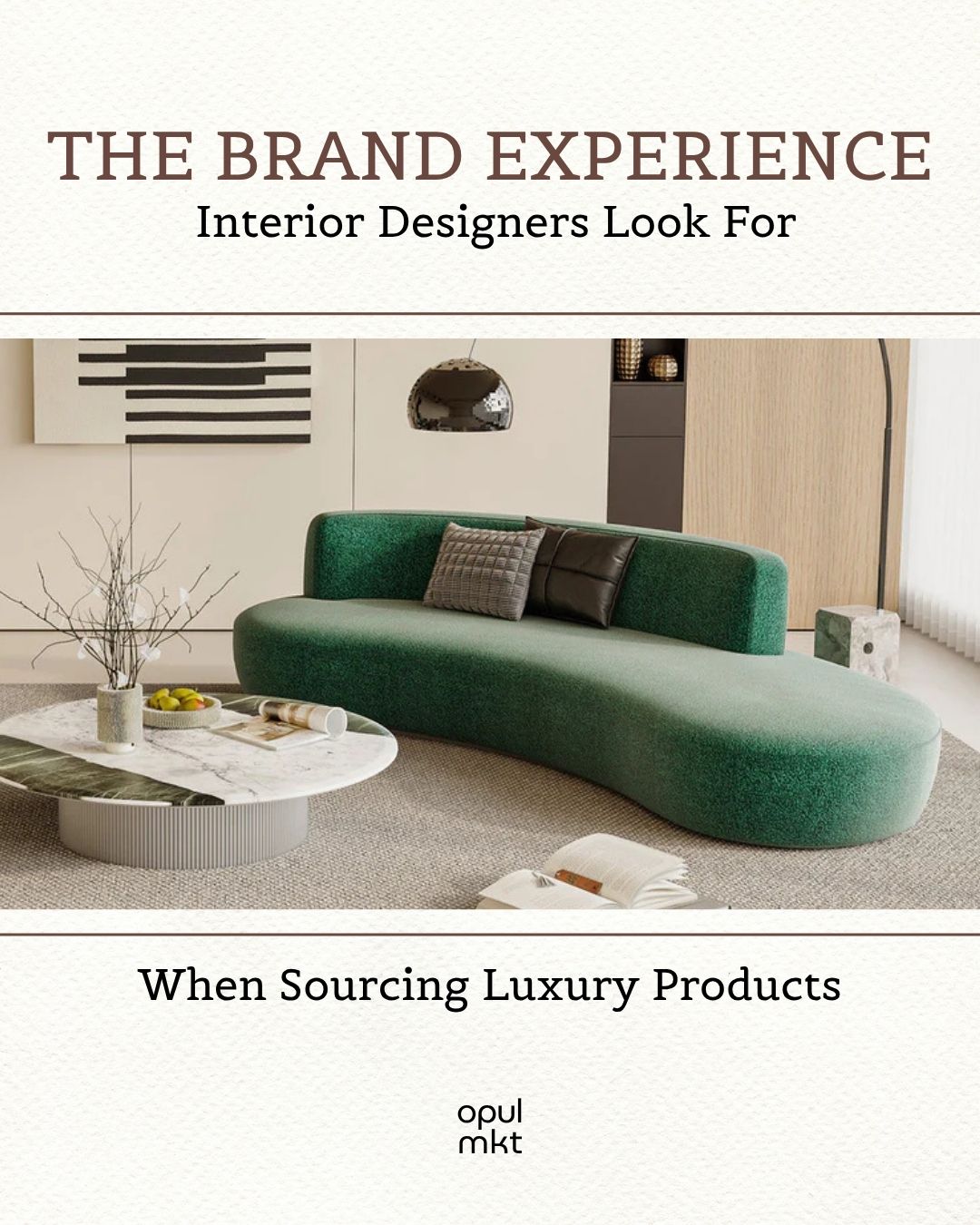
What Luxury Designers
Actually Look For
When They Source.
When a designer sources a luxury product for a client project, they are not simply purchasing an object. They are making a professional commitment — attaching their reputation to a maker, a platform, and a promise of quality.
This guide maps precisely what interior designers are actually looking for when they source luxury products — because it is the standard Opul Mkt is built to meet.
The product is only half of what a designer is evaluating. The other half is the brand behind it.
Trust Is the Foundation —
Built Before Any Transaction

Luxury designers are conservative about adding new vendors. The reason is straightforward: every vendor they specify is a link in a chain of professional commitments to their client. If any link fails — a missed lead time, a product that does not match the specification, a damaged delivery that takes months to resolve — the designer bears the reputational cost.
This conservatism means that trust must be established before a designer will even consider placing a first order. And because most of that trust-building happens before any conversation, the brand experience a platform projects through its presentation, positioning, and product information is the primary trust signal a designer must work with.
Experienced designers are skilled readers of brand quality. They assess a supplier's trustworthiness through a rapid evaluation of signals that most suppliers do not know they are projecting:
A supplier who performs impeccably on a first order earns a level of loyalty that is difficult to displace. Designers who trust a vendor will return for every suitable project — and will recommend them to other designers in their professional network. At the luxury level, this word-of-mouth dynamic is the primary growth mechanism for trusted supplier relationships.
Opul Mkt is built as a trust-first platform: curated makers, material-specific product information, and positioning that is unambiguously for design professionals. Designers evaluating the platform at opulmkt.com find the signals that establish credibility before any conversation is required.
Clarity Before Engagement —
What Designers Need to See Upfront

The single most common reason a designer does not engage with an otherwise suitable supplier is insufficient information. Not insufficient products — insufficient information about the products that exist. The specification detail, material description, and finish options that allow a designer to assess whether a product fits their project brief without having to initiate a conversation.
In the luxury market, where every specification decision carries professional weight, a designer will not invest time in an enquiry for information that should be available upfront. They will move to a supplier that makes the information accessible. The platform that removes this friction earns the engagement.
- —Wood species, grade, and finish treatment — not just 'solid wood' or 'natural finish'
- —Stone type, finish, and natural variation characteristics — not just 'marble' or 'stone'
- —Textile fibre content, weave structure, and cleaning specifications
- —Metal finish name, process, and expected patina behaviour over time
- —FR rating and commercial suitability for hospitality specifications
Furniture and objects are specified to rooms with known dimensions, clearances, and proportional relationships. A designer cannot specify a piece whose dimensions are given as approximations. Lead time accuracy, dimensional tolerances, and weight are all required information for professional specification.
In luxury design projects, lead times are project constraints — fixed points against which every other procurement decision is sequenced. A lead time that is quoted optimistically and delivered late does not just affect one item; it can cascade across an entire installation schedule. A supplier who is honest about lead times earns more trust than one who quotes short times and misses them consistently.
A platform that clearly states what can be modified — finish, dimension, material, upholstery — allows designers to assess feasibility before engaging. A platform that presents all products as 'customisable' without specifying parameters forces designers to waste time on enquiries that prove unworkable.
Every product in the Opul Mkt collection is presented with the specification depth designers need to assess fit before any conversation. Material details, finish options, lead time commitments, and customisation parameters are available upfront at opulmkt.com — because the designer's time is not a negotiating chip.
The Advisory Role —
What Separates a Vendor from a Partner

At the luxury level, the sourcing relationship a designer most values is not transactional. It is advisory. The difference is significant: a transactional vendor sells products; an advisory partner helps a designer solve problems, make better decisions, and deliver better outcomes for their clients.
This advisory relationship is earned over time — through demonstrated expertise, through proactive communication, through the willingness to say 'this is not the right product for that application' rather than closing a sale that will create a problem later.
- →Material expertise — The ability to explain why a specific material is or is not appropriate for a specific application, not just what it looks like
- →Project consultation — Engagement with the designer's specific brief, not just presentation of the catalogue
- →Honest constraint communication — Proactive disclosure of limitations before they become the designer's problem on a live project
- →Post-sale support — Active involvement in the resolution of any issues during production, delivery, or installation
- →Product knowledge depth — The ability to answer technical questions about construction, finish durability, and maintenance
In the luxury trade, the quality of the individual relationship with a sales representative or account manager is often as important as the quality of the products being sourced. A knowledgeable, responsive, personally invested rep can make an average product line feel premium to a designer who knows they will be looked after. Designers who have a strong rep relationship will call that rep first when a project need arises — before searching a catalogue.
Opul Mkt's trade programme provides designers with direct access to sourcing consultation — project-specific guidance on customisation feasibility, material selection, and specification support before any formal order is placed. Apply for trade access to connect with the Opul Mkt team directly.
Reliability —
The Standard That Cannot Be Compromised

Every other quality a luxury supplier possesses — beautiful products, clear specification information, intelligent advisory capability — becomes irrelevant if the supplier cannot be relied upon to deliver. Reliability is therefore not a differentiating quality in the luxury sourcing market. It is the baseline requirement.
- ·Written confirmation of all specifications — not just SKU and quantity
- ·Accurate lead time commitment at point of order, with a defined process for changes
- ·Named point of contact for the order, not a ticket number in a general queue
- ·Proactive communication at production milestones — particularly for custom or long-lead items
- ·Early warning of any schedule changes, with sufficient lead time for the designer to manage client expectations
- ·Accessibility of the production contact when needed
- ·Accurate dispatch notification with a realistic delivery window
- ·Product condition on arrival that matches the specification — damage addressed immediately
- ·Documentation supporting quality control — packing lists, condition reports, care instructions
- ·Problems occur in every supply chain — the question is how the supplier responds when it does
- ·A supplier who takes ownership, communicates proactively, and resolves quickly earns more trust
- ·The resolution process is one of the most significant trust-building experiences a designer will have
Long-Term Relationships —
What Luxury Vendors Are Actually Competing For

In the luxury sourcing market, the commercial prize is not the first order. It is the long-term vendor relationship — the placement in a designer's permanent sourcing portfolio that generates repeat business across multiple projects over multiple years, and the referrals to other designers in the same professional network that multiply the commercial value of a single relationship.
Understanding this changes the commercial logic entirely. The question for a luxury sourcing platform is not 'how do we generate maximum first orders?' It is 'how do we perform well enough on the first order to earn a permanent place in the designer's vendor portfolio?'
The designers who develop the deepest vendor relationships are those who have experienced a supplier performing well under pressure — a tight deadline met, a customisation problem solved creatively, a damage claim resolved quickly and generously. These are the moments that build genuine loyalty, because they demonstrate that the supplier's commitment to the relationship is not contingent on everything going smoothly.
Experienced designers curate their vendor portfolios deliberately. They maintain a core list of trusted suppliers they specify consistently, supplemented by specialist suppliers for specific material categories. Adding a new supplier to the core list is a high-bar decision — it requires demonstrated reliability across at least one full project cycle. For a new platform to earn this placement, it must invest in the relationship before the relationship returns commercial value.
In the luxury design community, supplier recommendations move through professional networks with significant velocity. A designer who has had an excellent experience with a supplier will mention it to their peers — at industry events, in professional association settings, in the casual conversations between studios that constitute the informal intelligence network of the design trade. The luxury sourcing market is smaller than it appears. Reputation travels fast in both directions.
Trade Protection —
Non-negotiable for Professional Sourcing

One of the most significant trust issues in luxury sourcing is the question of trade protection: does the supplier sell the same products to the designer's clients at retail? If the answer is yes, or is unclear, the designer's ability to add professional value through specification is directly undermined.
The designer's value proposition to their client rests partly on access — access to products, makers, and customisations that the client could not find independently. A supplier that sells to designers and their clients simultaneously through the same retail channel collapses this access advantage and makes the designer's specification redundant.
- —Products that are genuinely not available at retail, or available only in standard configurations that do not match what trade clients can access
- —Pricing that reflects a genuine trade discount, not a nominal reduction from an inflated retail price
- —Customisation options that are accessible only through trade relationships — finishes, dimensions, and materials not available to retail buyers
- —A clear, stated policy on direct-to-consumer selling — and what happens when a designer's client discovers the same product at retail
Opul Mkt operates as a trade-first platform. The Opul Mkt trade programme provides designers with access to makers, collections, and customisation options that are not available through retail channels — preserving the designer's access advantage and the professional value of their specification.
The Brand Experience in Full —
What Opul Mkt Delivers

The brand experience interior designers look for when sourcing luxury products is not a single quality. It is a complete experience — beginning before the first conversation and continuing through the full lifecycle of every order. Every interaction with a platform either builds or depletes the trust that determines whether a designer returns.
Every touchpoint. Every order. Every project.
Luxury designers are not looking for products. They are looking for a brand experience they can trust enough to attach their professional reputation to. That is the standard Opul Mkt is built to meet.
Save This. Share It. Use It.
Save for evaluating new sourcing platforms and trade partners · Share with studio teams and junior designers building their vendor portfolio · Share with clients who want to understand the value of professional luxury sourcing.


Leave a comment
This site is protected by hCaptcha and the hCaptcha Privacy Policy and Terms of Service apply.