

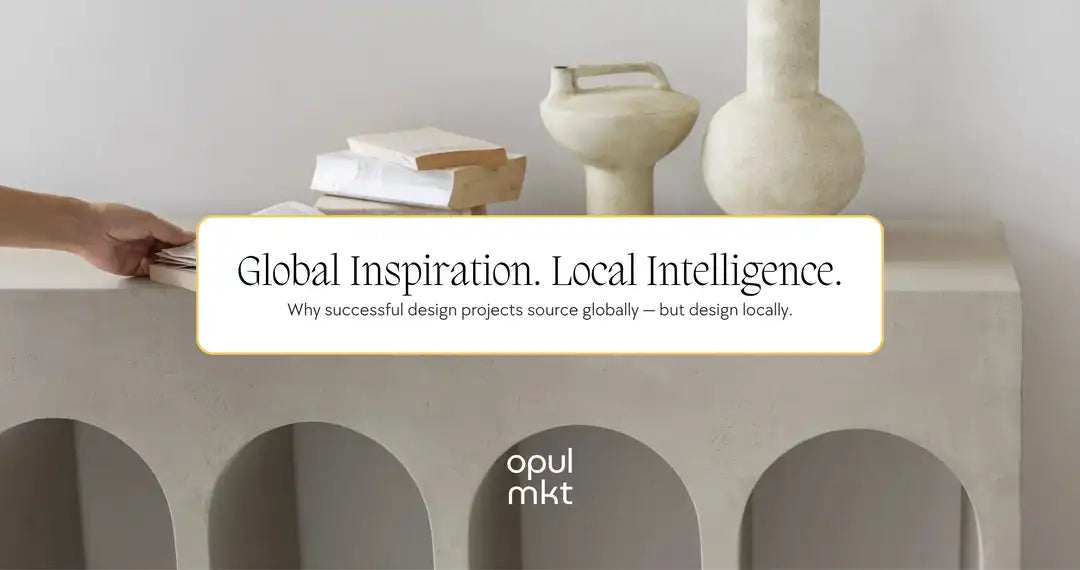
Why the world's most successful designers source internationally — but design locally. A guide to the three forces that make or break a cross-continental project.
A moodboard pulled from three continents means nothing if it lands in the wrong light, at the wrong latitude, in a home built around the wrong rituals.
The world's design market has never been more open. Procurement teams source stone from Portugal. Architects specify lighting from Copenhagen. Developers in the Gulf look to Milanese studios for residential vision. The cross-continental flow of objects, ideas, and aesthetics has created a genuinely international design language.
But language is only half of communication. The other half is context — and context, in interior design, lives in sunlight angles, in the way a family moves through a home at 7 p.m., in the particular texture expectations a craftsperson from one culture brings to a material specification. These are the invisible forces that determine whether a globally sourced project succeeds or falls flat.
This is the challenge — and opportunity — that defines serious design practice today. And it's precisely where Opul Mkt was built to help.
— ✦ —
Source globally with local intelligence. Opul Mkt connects designers to curated international makers — from handwoven textiles and bespoke furniture to architectural lighting — with the contextual knowledge to make every specification perform in its actual setting.
Three Forces That No Mood Board Can Carry
THE DESIGN INTELLIGENCE FRAMEWORK
- I. Daylight Behaviour — A finish that reads as warm cream in Oslo reads as bleached bone in Chennai. Understanding how latitude, season, and orientation transform a material is foundational — not an afterthought.
- II. Social Ritual — The way a household gathers for meals, receives guests, or marks transitions differs profoundly across cultures. A layout optimised for Copenhagen may be subtly wrong for a home in Jaipur or Lagos.
- III. Craft Expectation — Regional craftsmanship carries its own standards for joinery, surface finish, and tactile quality. Specifying globally without understanding local craft expectations can produce results that satisfy neither client nor maker.
These three forces don't appear on Pinterest boards or in international showrooms. They live in the lived experience of the place — and in the intelligence of the designer who knows how to read them.
— ✦ —
"An interior design studio working internationally must understand how light behaves in different latitudes, how social rituals shape layouts, and how regional craftsmanship can elevate a project."
— Nolita Harbour, on global studio practice
01 — Light
The Latitude Problem
Every material specification is an implicit bet on how light will behave. Veined marble that looks alive under northern European diffused light can appear flat and chalky in the direct glare of a south-facing room in the Gulf. Warm brass that reads as refined in winter light can shift towards garish under summer sun at lower latitudes.
This is not a minor nuance. It is a structural challenge for any designer working across climatic zones — and one of the most common reasons that internationally referenced projects fail to translate in practice. The finish that anchored a Parisian apartment mood board was photographed in October light. The home it's destined for receives six hours of direct sun from the south-west from April to October.
Opul Mkt Approach When you source through Opul Mkt, product context includes regional performance data — how materials behave under different light conditions, which finishes are most frequently specified in comparable climatic contexts, and which combinations have been validated by designers working in your latitude.
Smart sourcing requires light intelligence. Not just access to beautiful things — but access to how beautiful things actually perform in the light conditions of the project at hand. This is especially true for natural-fibre rugs whose warm tones deepen under northern overcast and shift under direct equatorial light, and for lighting fixtures whose warmth or coolness of output shifts in perception entirely based on the ambient light they enter.
Light-responsive material choices start here. Explore natural-fibre rugs that perform across climates, wall art and textural hangings that read beautifully in both diffused and direct light, and architectural lighting specified for warmth and spatial depth regardless of latitude.
02 — Ritual
How a Family Actually Lives
Open-plan kitchen-living layouts became the dominant residential typology in Western design over the past two decades. The logic — visibility, connection, informality — maps neatly to a particular set of domestic rituals: casual entertaining, the kitchen as social hub, children at counters while parents cook.
In many parts of South Asia, the Middle East, and East Asia, domestic life is organised around different spatial logics. Formal and informal receiving spaces serve distinct social functions. Kitchen visibility is often deliberately contained. Guest rooms carry a weight that no Scandinavian minimalism manual has ever fully reckoned with.
When globally sourced furniture and objects are specified without accounting for these spatial logics, they create an uncanny result: beautiful rooms that somehow don't serve the life being lived inside them.
KEY DESIGN INSIGHTS
- Spatial Intelligence Before Specification: Understanding how a household uses space should precede every sourcing decision. The object serves the ritual, not the other way around. Begin with sofas and sectionals configured for the actual gathering geometry of the household.
- The Guest Room Question: In many Asian and Middle Eastern households, the guest room is a social statement. Its specification deserves proportional design attention — from the nightstands to the ambient lighting.
- Indoor–Outdoor Thresholds: The relationship between interior and exterior varies enormously by climate and culture, and should shape material decisions from the outset.
- Gathering Geometry: Seating configurations that feel natural to a Western entertaining logic can feel awkward in contexts where gathering patterns are more hierarchical or circular. Ottomans and poufs offer flexible, culturally adaptable gathering solutions.
Source Globally. Design Locally. Opul Mkt connects designers to curated international suppliers — with the regional context to make global sourcing work for your specific project, climate, and client. Explore the full furniture collection, handmade rugs, and decorative objects at opulmkt.com
Are you a design professional working across borders?
Join the Opul Mkt Trade Program for exclusive trade pricing, early access to new collections, and personalised sourcing support — from single residences to multi-property hospitality briefs across any continent.
03 — Craftsmanship
What the Hands Know
Craftsmanship is not a single standard. It is a collection of traditions, each with its own vocabulary of quality. A Portuguese furniture maker and a Rajasthani woodworker bring different ancestral knowledge to the same material brief — different tolerances, different finishes, different conceptions of what constitutes excellence.
When international specifications meet local execution without that mutual understanding, the result is often one of two failures: either the craftsperson produces something technically correct but culturally foreign to their own material tradition, or the specification is simply beyond what local resources can deliver without proper dialogue and preparation.
The best global studios have learned to treat local craftsmanship not as a fallback, but as a creative resource. They arrive at a project knowing which traditions exist in the region, which material languages those traditions speak, and where global specification can be enhanced by local interpretation.
The Opul Mkt Position Craftsmanship resonates universally. Handwoven textiles, bespoke joinery in our furniture collection, and artisanal finishing across our decorative objects and wall art create a sense of authenticity that transcends geography — but only when specification and execution are in genuine dialogue. Opul Mkt helps designers find suppliers who understand both sides of that conversation. Explore our global creators network to discover the studios and artisans behind every piece.
— ✦ —
In Practice
What This Means for Your Next Project
The evolution of international design practice has produced a genuinely exciting moment: designers can access the best of global manufacture and material culture, while the most sophisticated clients now actively value cultural intelligence alongside visual sophistication.
But that moment creates a responsibility. Sourcing globally without designing locally is an aesthetic import exercise. It produces rooms that look internationally credible but feel slightly displaced from the life being lived in them — beautiful, but not quite right.
The designers navigating this best are those who treat local light, local ritual, and local craft not as constraints on their international vision, but as the conditions that make that vision real. They source from the world. They design for the place.
Opul Mkt was built for exactly this practice — a platform where global sourcing is matched with the contextual intelligence to make it work wherever in the world your project lands. Learn more about our sourcing philosophy.
Source From the World. Design For the Place. Global inspiration becomes great design only when it is grounded in local light, local ritual, and local craft. Opul Mkt gives designers the sourcing access — and the contextual intelligence — to make every internationally specified project feel exactly right where it lands.
→ Explore the Collection → Meet the Makers → Join the Trade Program
Explore Designer Lighting | Shop Handmade Rugs | Browse Sofas & Sectionals | Wall Art & Sculptures | About Opul Mkt


Leave a comment
This site is protected by hCaptcha and the hCaptcha Privacy Policy and Terms of Service apply.