

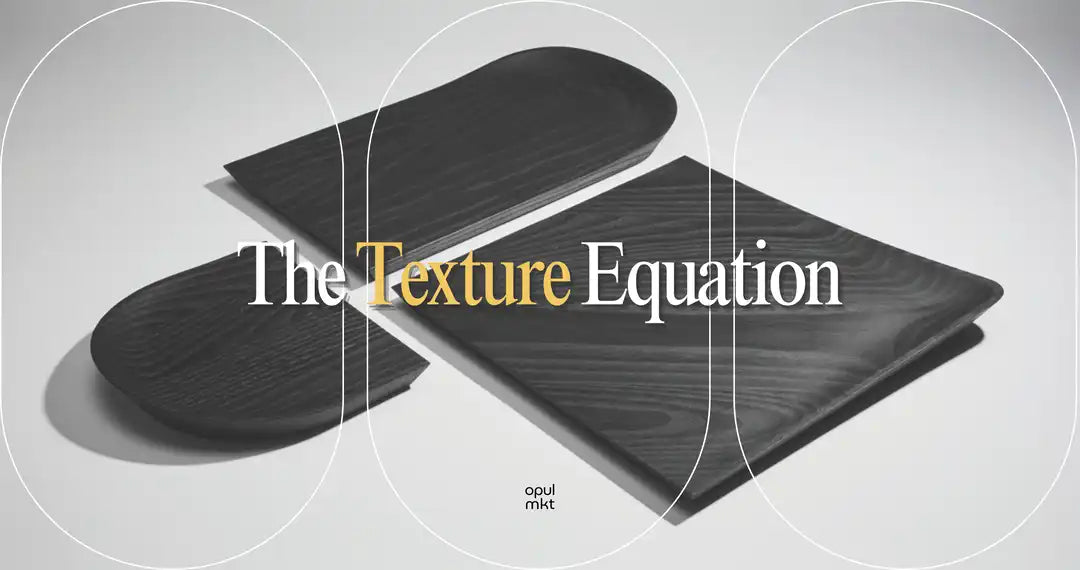
The Room That Stops You
There is a kind of room that stops you at the doorway — not because it is loud, but because it feels felt. Your eyes move slowly. Something draws you in before you can name it. That pull is almost never the paint colour. It is almost always texture.
At Opul Mkt, we work with designers who understand that restraint is its own kind of drama. This guide is for them — and for anyone who wants to understand how the most enduring, deeply luxurious interiors are actually built: not with trend, not with excess, but with the quiet intelligence of layered material.
Build your textured foundation from the floor up. Start with a handwoven wool or jute rug, layer in seating upholstered in natural textiles, and finish with artisan lighting that catches the room's material depth.
Texture Is the New Colour Drama
The design conversation has shifted. Where once a bold paint colour or a statement wallpaper was the tool of impact, the most considered interiors today use texture to do that same emotional heavy lifting — with none of the noise.
Texture adds depth without clutter. It creates rooms that feel rich rather than decorated, complete rather than curated. A space with a monochromatic palette and a wool rug, a stone surface, and a linen sofa will almost always feel more luxurious than a room chasing colour for the same effect.
Materials like linen, stone, brushed metal, and wood are no longer supporting cast — they are the story. As the quiet luxury movement continues to shape the market, one constant remains: texture as the primary vehicle for depth and meaning.
Texture is more than touch. It is emotion, memory, and the feeling of light hitting a raw silk curtain at eight in the morning.
The Three-Layer Framework
Every well-textured room is built in sequence. Think of it less like decorating and more like composition — a foundation, contrast, and a detail.
Layer 1 — The Foundation
Anchor your space in organic, breathable, matte-finished textiles and surfaces. Linen, cotton, and natural wood set a calm, adaptable canvas. These are your largest pieces — they should read as settled, not flashy.
- Linen sofa or sectional
- Natural oak or timber flooring
- Matte plaster or limewash walls
Layer 2 — The Contrast
Introduce opposing tactile experiences. Hard against soft. Smooth against rough. Matte against a subtle gleam. A stone coffee table against a linen sofa is the quintessential quiet luxury juxtaposition — and it works because neither material competes for attention.
- Stone or travertine coffee table — beautifully complemented by artisan case goods
- Bouclé accent chair
- Brushed brass hardware or lamp
Layer 3 — The Detail
Layer in smaller tactile moments — the velvet cushion on a linen sofa, the hand-thrown ceramic bowl on the stone surface, the wool rug grounding everything underfoot. These details signal that the room was considered, not assembled.
- Wool or jute area rug
- Ceramic or handmade vessels — explore decorative objects and sculptures
- Velvet or linen scatter cushions
The detail layer is where a room becomes a collection. Ground every space with a handmade rug, introduce sculptural objects with genuine material presence, and let wall art and hangings add the final layer of considered depth.
Signature Pairings That Always Work
The magic is not in a single material — it is in the friction between materials. These are four combinations we return to, and why they hold.
Wool Rug + Stone Table + Linen Sofa
The classic quiet luxury trio. Warm woven material against cold mineral weight and airy natural fibre. No one texture dominates. The room feels assembled over years — which is exactly the point. Best for living rooms. Anchor with a handwoven wool rug and a linen sofa from Opul Mkt's curated collection.
Plaster Wall + Velvet + Raw Wood
Matte mineral meets plush, light-catching fabric against the organic warmth of untreated timber. Each element tells a different story of making, and together they create a room that feels simultaneously ancient and precise. Ideal for bedrooms and studies.
Bouclé + Travertine + Brushed Brass
Nubby loop weave against the fossil-rich surface of travertine and the understated warmth of matte brass. This combination reads as deeply curated without being self-conscious — the signature of a room designed rather than decorated. Pair with brushed brass lighting to complete the effect.
Linen Drapery + Honed Marble + Rattan
Soft movement at the windows, cool mineral weight below, and the natural woven grid of rattan introducing warmth and handcraft. Particularly effective in spaces where light is central to the experience. Introduce textural wall hangings to carry the layering upward.
The goal is cosy, not cluttered. If every piece in the room has the same finish, the room is unfinished.
Are you a design professional?
Join the Opul Mkt Trade Program for exclusive trade pricing, early access to new collections, and personalised sourcing support across residential, hospitality, and commercial projects.
Six Rules for Layering Without Chaos
Texture without discipline becomes noise. These are the principles that separate rooms that feel intentionally rich from rooms that simply feel busy.
Rule 1 — Limit to Three Textures Per Zone
More than three dramatically different textures in one sightline starts to compete rather than converse. Choose one dominant, one contrast, and one accent — then hold.
Rule 2 — Always Pair Rough with Smooth
The eye needs contrast to perceive depth. Polished marble reads more beautifully against rough linen than against another smooth surface. Opposition creates the richness.
Rule 3 — Balance Warm and Cool Textures
Textures carry temperature. Wool, velvet, and timber read as warm. Stone, glass, and plaster read as cool. A room built entirely in warm textures feels heavy; all cool reads sterile. The balance is the comfort.
Rule 4 — Use Scale Intentionally
Heavier, more substantial textures belong on large pieces — upholstery, rugs, headboards. Lighter or more intricate textures belong in smaller accents. This hierarchy makes the layering legible.
Rule 5 — The Black-and-White Test
Photograph your space in black and white. Without colour, you will see immediately whether the textures are doing their work or flattening into one undifferentiated surface. If it reads well in monochrome, it will feel layered in colour.
Rule 6 — Let Natural Materials Age
Stone, brass, linen, and timber are selected for their quality partly because they improve over time. The slightly worn stone edge, the patina on a brass pull — these are not flaws. They are proof of a considered investment. Browse Opul Mkt's sourcing philosophy to understand how we select for exactly this quality.
Start with One Honest Material
You do not need to redesign a room. You need to introduce one material that is genuinely beautiful to touch, and let everything else respond to it. That is where a textured interior begins — and where trend-chasing ends.
The most enduring interiors are built slowly, with conviction. They are rooms that reward second looks and daily living in equal measure. Texture is the tool that makes this possible.
The Most Enduring Rooms Are Built in Layers, Not Trends. Start with one honest material. Let every subsequent choice respond to it. Opul Mkt curates the pieces that make this possible — from the foundation rug to the finishing sculpture.
→ Shop Handmade Rugs → Explore the Furniture Collection → Join the Trade Program
Explore Designer Lighting | Shop Handmade Rugs | Browse Artisan Seating | Wall Art & Sculptures | About Opul Mkt


Leave a comment
This site is protected by hCaptcha and the hCaptcha Privacy Policy and Terms of Service apply.