
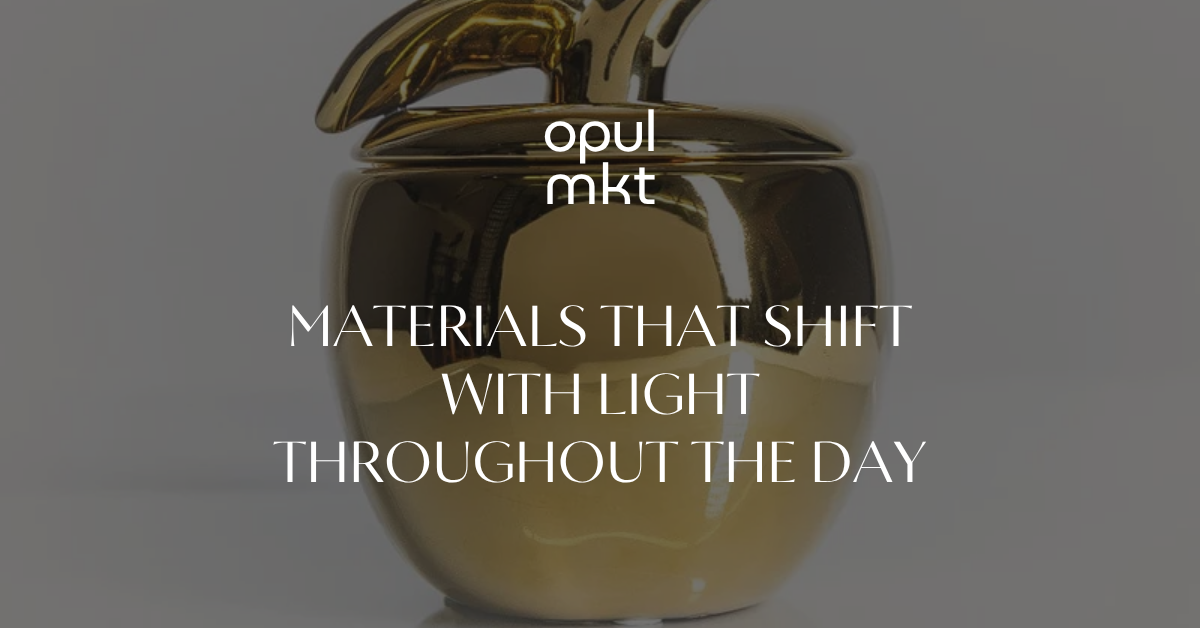
A room can have beautiful furniture, premium finishes, and a strong layout — but if the materials were specified without considering how light moves across them through the hours, the entire experience is incomplete. The designer who understands light understands materials differently: not as static objects to be photographed, but as dynamic surfaces that perform across time.
"The best interiors do not fight daylight. They work with it — and the materials that furnish them are chosen for how they change, not just how they look."
01 — Why Light Changes Everything in a Room
 Lighting is one of the most powerful tools in interior design because it affects how a space looks, feels, and functions simultaneously. The same room reads completely differently under cool morning light streaming from the east, warm afternoon light raking across a textured plaster wall, and the intimate amber of evening lamp light. These are not variations on the same room — they are, perceptually speaking, different rooms.
Modern humans spend more than 90% of their lives indoors, which means the quality of light inside a space shapes mood, cognitive performance, and physical wellbeing in ways that are only beginning to be fully understood. The designer who treats light as a decorative afterthought — something to address once the furniture is chosen — has inverted the correct design sequence.
What Light Actually Does to a Room
- Changes Perceived Scale and Proportion Bright, even light can open a compact space, but too much uniform light removes character and flattens depth. Strategic shadow creates dimension that no furniture arrangement can replicate.
- Reveals or Suppresses Material Texture Grazing light from the side brings out the surface variation of textured plaster, ribbed timber, and woven textiles. Direct overhead light flattens the same surfaces entirely.
- Shifts Material Colour Significantly Stone slab colour reads differently under tungsten than under daylight. The warm tones in a walnut surface deepen under incandescent and cool under north-facing natural light. Upholstery that reads as sage in the showroom may read as grey in a north-facing room.
- Governs Atmosphere and Emotional Register Warm, diffused light feels relaxing and intimate. Cool, brighter light reads as alert and task-oriented. The same living room can feel cosy in the evening and crisp in the morning — simply because the light has changed.
Every piece in the Opul Mkt collection is specified with material, finish, and surface documentation — the information needed to assess how a piece will behave under the actual light conditions of the room it is entering, not just how it photographs under studio lighting.
02 — How the Day Moves Through a Room
 The trajectory of natural light through a space across a full day is one of the most important design variables in a room — and one of the least systematically considered. Window orientation, glazing quality, shading, and the reflective behaviour of adjacent surfaces all determine how a room performs hour by hour. A designer who has observed only one hour of a room's light has observed only one room.
A south-facing room with strong direct sunlight places entirely different demands on its materials than a north-facing room with consistent but cool indirect light. The same stone, the same timber, the same textile — in different orientations — will produce different rooms. This is not a marginal consideration. It is central to every material specification decision.
Low angle east light grazes surfaces horizontally. Texture is maximised. Stone veining comes alive. Timber grain becomes three-dimensional. This is when material depth earns its specification.
High angle light reduces surface shadow and flattens texture. Colour reads most accurately. Pale stone may appear washed. This is the hour that reveals how materials hold their own without shadow support.
Golden, low-angle west light brings warmth to every surface. Timber glows. Stone takes on amber undertones. Textiles appear richer. Earthy palettes justify themselves at this hour.
Artificial light takes over. The quality of the fixture — colour temperature, direction, diffusion — now determines everything. A room designed only for daylight performance is only half designed.
The Orientation Principle
A north-facing room may need a fundamentally different lighting strategy than a south-facing one. A space with large windows may need dimmable fixtures to balance bright daylight, while a darker interior room may require more layered artificial lighting to compensate. Designers should think about daylight in terms of direction, intensity, distribution across the day, and interaction with finishes, glare, and shadows — before a single material is selected.
03 — Six Materials and How They Respond to Light Across the Day
The materials that perform most compellingly across the full day are those with inherent surface variation — natural materials whose organic structure means no two moments of light produce exactly the same reading. Understanding how each material behaves under different light conditions is not an optional refinement in the specification process. It is the specification process.
Natural Stone — Marble & Travertine
Low raking light reveals depth and movement in the slab. Veining that appeared subtle in the showroom becomes a dominant compositional element. Crystalline minerals catch and return the light.
Under warm artificial light, the stone reads as a single warm tone. The veining recedes. The surface becomes a backdrop rather than a feature — the correct register for a dining or living room at night.
Natural stone furniture — in marble, travertine, and mineral finishes — with slab-variation documentation and sample dispatch capability is available through the Opul Mkt furniture collection.
Solid Timber — Walnut & Smoked Oak
Raking morning light throws timber grain into relief. A walnut surface that read as flat under midday overhead light becomes richly dimensional, its figure catching directional light from across the room.
Under warm tungsten or warm LED, dark timber deepens further. The warmth of the wood absorbs and returns the warmth of the light. Dark-timber rooms were made for evening.
Solid hardwood furniture with honest finish treatments — specified for grain character and temporal light behaviour — is available through the Opul Mkt furniture collection.
Handwoven Wool — Hand-Knotted Rugs
Low light reveals the directionality of the pile — the rug appears to change colour as you move around it. This optical quality separates a hand-knotted rug from a machine-made alternative: the pile responds to light.
Under evening light, the rug becomes the room's warmest surface — absorbing light rather than reflecting it, contributing acoustic softness and visual anchor simultaneously.
Browse handwoven rugs at Opul Mkt — natural fibre pieces from artisan makers whose pile variation and light response are the product of genuine handcraft.
Natural Linen — Upholstery & Soft Goods
The open weave of heavyweight linen becomes legible under raking morning light. Surface variation within a single upholstered piece reads as intentional material complexity rather than inconsistency.
Under warm artificial light, natural linen takes on a cream-gold warmth it did not have in the showroom — which is why linen that appeared slightly cold in specification photographs reads as warm and welcoming in the inhabited room.
Natural fibre textiles — linen, wool, and natural blends for upholstery and soft furnishings — are available through Opul Mkt's textiles collection.
Unlacquered Brass — Metalwork & Fixtures
Under directional morning light, unlacquered brass catches and disperses light in small points that animate the room. A brass pendant or side table base becomes a compositional event.
Under warm artificial light, brass reads as gold — the most legible warm metal in the room. It unifies the material palette, warming stone, timber, and textile simultaneously.
Statement lighting and metalwork in natural materials — unlacquered brass, aged metals, and organic forms — is available through Opul Mkt's lighting collection.
Limewash & Plaster — Wall Surfaces
The defining quality of limewash is its temporal behaviour: it shifts in tone as light moves and breathes with humidity. Under morning raking light, the surface appears to have depth — alive with subtle variation.
In bold tones under evening artificial light, limewash walls create a genuinely dynamic interior atmosphere. A room that is perceptibly different at 9am and 9pm — this temporal quality is the defining characteristic of materials with genuine depth.
Sample dispatch is available across the Opul Mkt collection. Assessing the sample under the room's natural light orientation before specifying is not optional. It is the specification process.
04 — Colour Temperature and Rendering — The Most Overlooked Variable
A space may look completely different under two light sources with identical brightness but different colour temperature and rendering characteristics. Skin tones, paint colours, timber finishes, stone slabs, and fabrics can all shift noticeably. This is why lighting must always be considered alongside — not after — the material palette.
Colour temperature (Kelvin): lower numbers (2700–3000K) produce warm, amber-toned light; higher numbers (4000K+) produce cool, blue-toned light. Colour rendering index (CRI) measures how accurately a light source renders material colours. High CRI makes materials look true to life. Low CRI can make a carefully specified stone surface appear flat and lifeless.
| Space | Temperature | What It Does for Materials |
|---|---|---|
| Living rooms & dining rooms | 2700–3000K | Makes timber richer, textiles softer, and natural stone warmer. Supports the earthy, natural material palette that predominates in considered residential design. |
| Bedrooms | 2700K or lower | Warm light supports the transition toward rest. Renders natural linen, wool, and cotton at their most inviting. |
| Kitchens & work areas | 3000–3500K | Accurate colour rendering for task work. Under-cabinet task lighting should be minimum CRI 90 to render food, surfaces, and materials accurately. |
| All spaces with natural materials | CRI 90 minimum | Below CRI 90, the material depth that justifies the specification cost becomes invisible. Stone, timber, wool, leather — all require high CRI to perform as specified. |
The material palette determines the lighting requirements. The lighting specification determines whether the material palette performs as specified. These are not separate decisions. They are the same decision, made in the same conversation, at the same point in the design process.
05 — Layering Light for Material Depth
 One ceiling fixture is rarely enough. Strong interior lighting combines three distinct layers, each with a defined role in the material and spatial composition of the room. When these layers work together, the result is a space with flexibility and visual richness. When they do not, interiors can feel flat, overlit, or functionally incomplete — regardless of the quality of the materials they illuminate.
General illumination establishing the base register. Reflected ambient light from walls and ceilings preserves material texture. Even recessed sources suppress it. The relationship between the ambient source and the room's surfaces determines whether texture reads or disappears.
Supports specific activities, assessed for colour temperature independently. A kitchen task light at 3500K will render differently on the stone worktop than the ambient source at 2700K. When well placed, the room becomes more practical without visual strain.
Draws attention to architecture, artwork, textured walls, or focal materials. Grazing light directed across a plaster or stone surface creates shadow and depth that ambient light removes. This is the layer most commonly omitted — and most missed when absent.
Common Lighting Mistakes That Undermine Material Performance
-
Relying Only on Recessed Ceiling Lights
Even, overhead illumination flattens every textured surface in the room. The handwoven rug, the textured plaster, the ribbed timber front — all become visually flat under a grid of recessed downlights.
-
Ignoring Dimming Controls
A well-lit interior should feel adaptable across the day. If every light is either fully on or fully off, the design is missing the layer of nuance that allows the room to shift from morning function to evening atmosphere.
-
Overlighting Spaces That Benefit from Shadow
Shadow creates depth and dimension. Strategic restraint — allowing some surfaces to remain in relative shadow — is what gives the lit surfaces their authority.
-
Specifying Fixtures Without Reference to Material Palette
The fixture finish must be assessed against the material palette under the same light conditions. A brushed brass pendant that reads as warm gold under 2700K becomes a cooler champagne under 4000K — a different material register, requiring a different specification response.
Opul Mkt's lighting collection is selected for warmth and material relationship — fixtures whose colour temperature, diffusion quality, and finish are documented alongside the material specifications of the pieces they are intended to accompany.
06 — Natural Materials as Living Surfaces
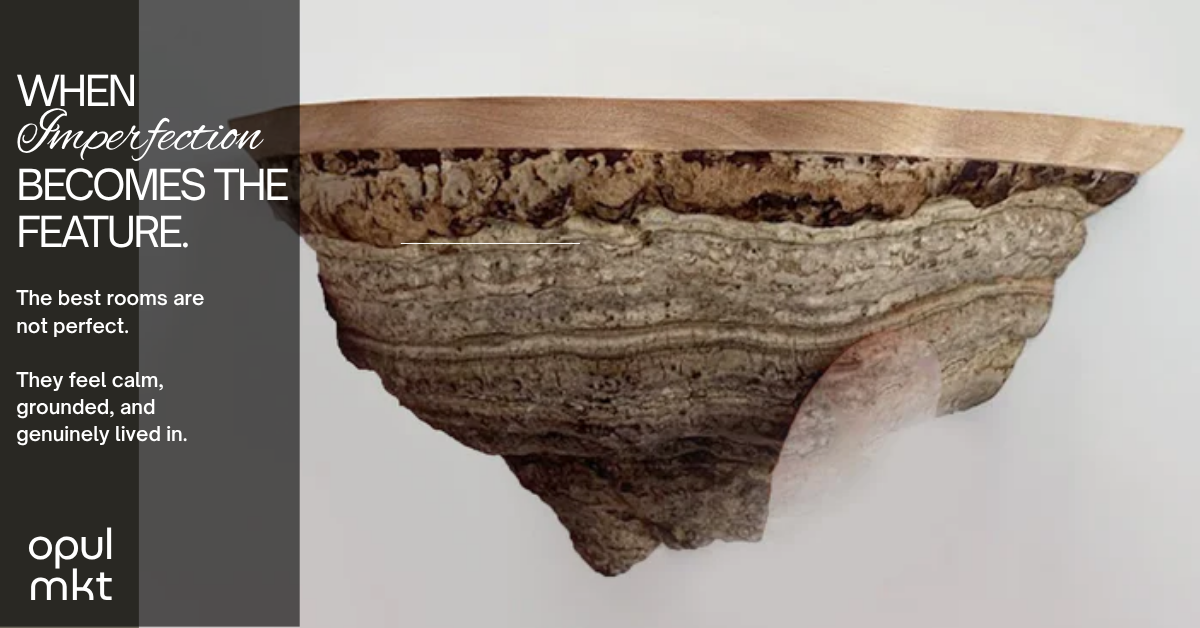
Natural materials — stone, timber, wool, linen, leather, natural plaster — are fundamentally different from synthetic alternatives in one critical respect: they have inherent variation. No two pieces of the same natural material are identical. And this variation is precisely what makes them responsive to light across the day.
The grain pattern in each plank of walnut is unique. The veining in each slab of marble is unrepeatable. The irregularity within the weave of a hand-spun wool rug is the evidence of its making. There is always something new to catch, something new to read, as the angle and quality of the light changes — which is the defining quality of a room that improves with time rather than degrading into familiarity.
The Specification Case for Natural Materials in Light-Sensitive Rooms
- Surface Variation Under Raking Light Specify natural materials in rooms where morning or evening raking light is present. The variation in their surface is what the raking light illuminates. A smooth, uniform synthetic surface has nothing to offer the raking light.
- Tonal Shift Across Temperatures Assess natural material samples under both the room's natural daylight orientation and the intended artificial light temperature. Stone, timber, and textile colourways can shift by a full tonal register between the two.
- Patina Development Over Time Natural materials develop their response to light over time. An oiled walnut surface deepens. A hand-knotted wool rug settles and softens. Natural stone acquires patina. The material specified on day one becomes a better material over years of occupation.
- Acoustic and Atmospheric Contribution Natural materials regulate the acoustic and atmospheric environment of a room as well as its visual one. Wool and linen textiles absorb sound. Natural stone regulates temperature. The effect is as immediate and significant as any visual specification decision.
07 — Specifying for Light at Opul Mkt
 Specifying materials for their behaviour under light — not just their appearance in photographs — requires a sourcing platform that provides the right information. Surface finish documentation, material composition, and the ability to assess samples under actual room conditions before committing to an order are not refinements on the specification process. They are the specification process, for a designer who intends the room to perform across the full day.
- Material Documentation Surface finish name, treatment process, and expected patina behaviour documented per maker — the information needed to assess how the material will age and how its light response will change over time.
- Sample Dispatch Capability Material samples, finish swatches, and textile samples dispatched before order commitment. Assessing the sample under the room's natural light orientation is the only reliable way to specify a material for its light behaviour.
- Slab Variation Documentation for Stone Stone slab colour and veining range documented per maker, with sample dispatch confirmed. A slab that reads as warm in the showroom under tungsten may read as cool under the north-facing daylight of the room it will enter.
- Lighting and Material Cross-Referencing The Opul Mkt lighting collection is selected in direct relationship to the material collection — fixtures whose colour temperature, diffusion quality, and finish support the natural material palette of the rooms they enter.
- Trade Consultation on Light and Material Pairing Project-specific guidance available through the trade programme on which material and finish combinations will perform under the room's specific orientation and lighting conditions.
"Specify for the room at every hour, not just in the photograph. The materials that shift with light are the ones worth specifying."
Explore by Material
Specify for Every Hour of the Day
Apply for trade access to consult with the Opul Mkt team on material and light pairing for your specific project orientation and conditions.
Sample dispatch available across the collection — assess under your room's actual light before committing to an order.



Leave a comment
This site is protected by hCaptcha and the hCaptcha Privacy Policy and Terms of Service apply.