
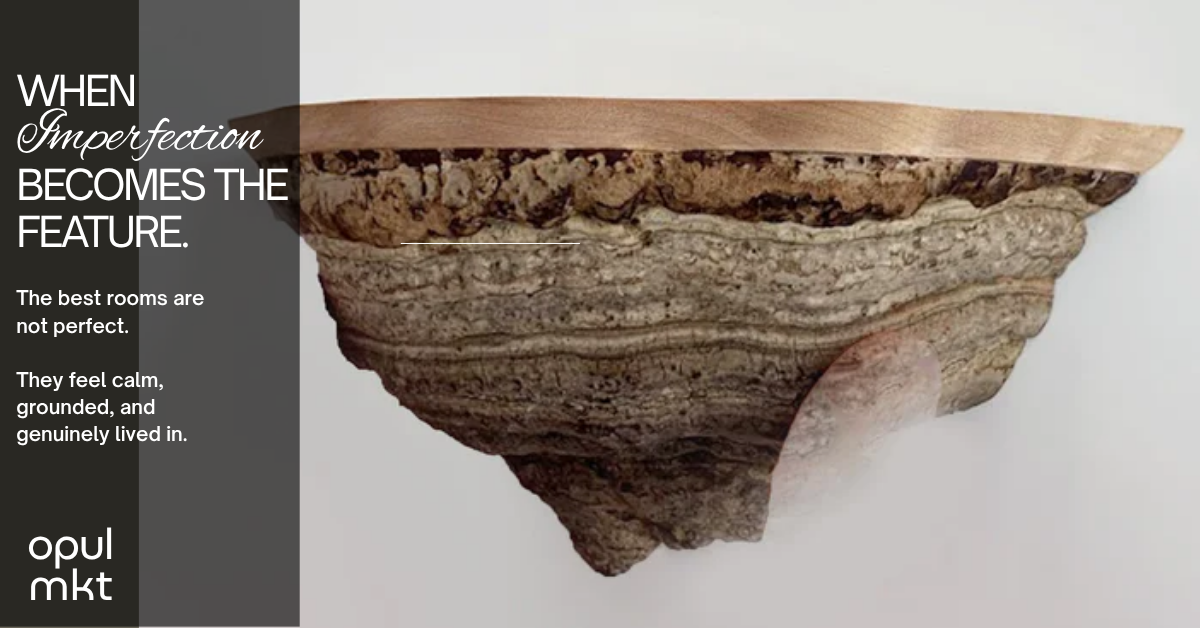
Forget the flawless, the symmetrical, the just-arrived. The rooms that people actually want to live in — the ones that feel calm rather than curated, inhabited rather than staged — are almost always built around a different set of decisions. Not more, but better. Not new, but genuine. Not perfect, but real.
"Beauty is already here. Wabi-Sabi is the design philosophy that stops trying to replace it with something more impressive — and learns to see it instead."
01 — What Wabi-Sabi Actually Means — And Why It Is Not Minimalism
 Originating in Japan and rooted in Zen Buddhism, Wabi-Sabi is not a style in the conventional sense. It is a philosophy — a way of seeing — that has found its most compelling expression in interior design precisely because design is where our values about beauty, permanence, and the passage of time become most visible.
The two words carry distinct but inseparable meanings. Wabi refers to simplicity, humility, and the quiet charm of understated things — the handmade pot that is slightly uneven, the linen that is not quite white, the table shaped by a maker who made decisions as they worked. Sabi is the beauty that comes with time — the patina on brass, the fading of natural fabric, the irregularities in a ceramic glaze that tell the story of how the piece was made and how long it has been used. Together, they describe an aesthetic in which imperfection is not tolerated but actively sought.
The Critical Distinction from Minimalism
About the reduction of form to its essential geometry: clean lines, resolved proportions, the discipline of restraint. It can be cold. It can be sterile. Visually perfect in the sense that nothing disrupts the composition.
Minimalism with soul. Not about having less for the sake of a formal argument, but about having only what is genuinely necessary — in forms that feel grounded, textured, and alive. A Wabi-Sabi room is not empty. It is quiet.
Three Principles That Define the Philosophy
Wabi — The Quiet Charm of the Understated
Simplicity, humility, the beauty of things that do not assert themselves. A low wooden table with clean lines. A linen sofa in muted tones. A single branch in a clay vase. Wabi spaces feel grounded because they are not trying to impress. They are trying to support the life that happens inside them.
Sabi — The Beauty That Comes With Time
A crack in a ceramic bowl. A knot in the wood grain. The patina that develops on an unlacquered brass surface over years of use. Sabi embraces these as part of the story, not flaws to be hidden. The mark of time is not damage. It is the evidence of a life lived in the presence of genuine materials.
Ma — The Meaning of Space Between Things
Negative space in Wabi-Sabi is not absence. It is presence of a different kind. The pause between objects. The wall left undecorated so the single piece that hangs on it carries its full weight. Ma is the silence that makes the music audible — the compositional intelligence that gives each piece room to be itself.
Every maker in the Opul Mkt collection is selected for the qualities that Wabi-Sabi values: material genuineness, construction integrity, and the surface character that only handcraft produces.
02 — Why This Philosophy Is Resonant Now
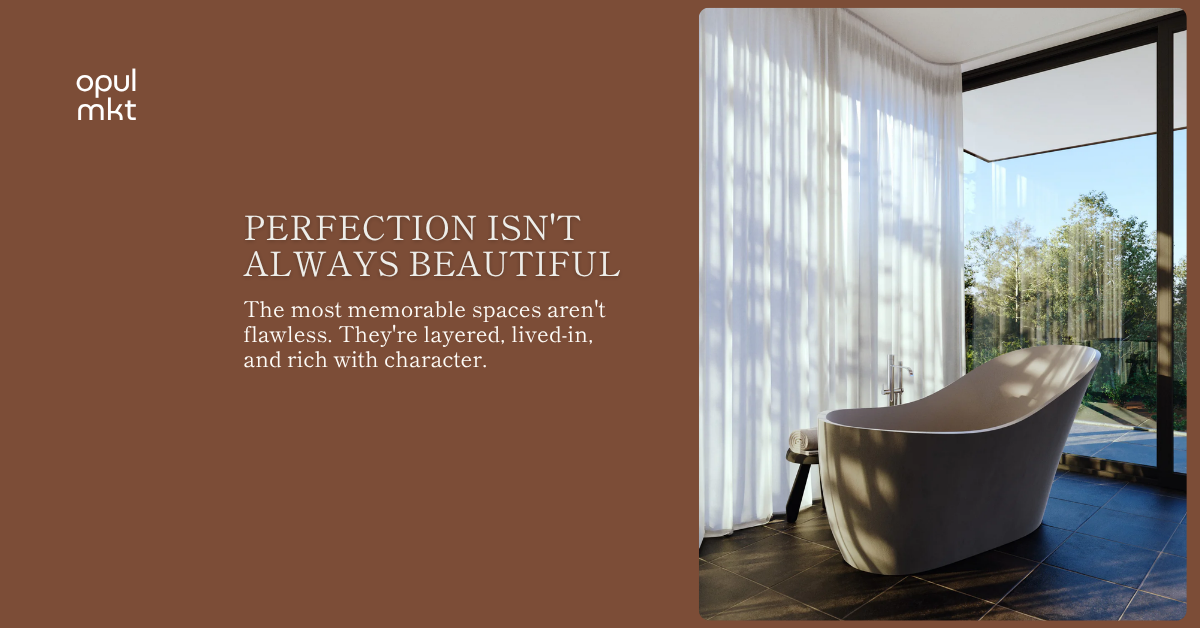
Modern life is fast, noisy, and full of pressure to keep up — with trends, with technology, with the curated perfection of the image feed. The glossy, matchy-matchy interior looks impeccable in photographs and feels dead to inhabit. There is no room in it for the life that is actually being lived. Wabi-Sabi resonates because it invites the opposite: to slow down, to appreciate the lived-in feel, to make peace with imperfection — and to recognise that a room which accommodates imperfection is a room that accommodates the person living in it.
This is not a passing trend. The impulse toward authenticity in interior design — toward spaces that feel real rather than styled, inhabited rather than staged — is a structural shift in what clients want from the spaces they commission. The designer who can deliver genuine Wabi-Sabi is the designer who understands that the client's brief, expressed in different words, is almost always: I want it to feel like me, not like a magazine.
A sanctuary, not a showroom. The absence of competitive decoration allows the room to support the person inside it rather than performing for the observer outside it.
Choosing genuine natural materials and celebrating ageing rather than replacement is an inherently sustainable position. A well-made piece of solid timber that develops character over decades is the opposite of fast furniture.
Unlike styles that require refreshment every few years as their references date, Wabi-Sabi ages with the room and the life being lived in it. A room that was right at specification becomes more right as it settles.
Clients who say "I want it to feel real" or "I don't want it to look dated in five years" are expressing the Wabi-Sabi sensibility without the vocabulary. The designer who recognises this can translate it into a material and spatial brief.
03 — The Six Materials of Wabi-Sabi
 The materials that Wabi-Sabi values are not chosen for their visual perfection. They are chosen for their surface complexity, their capacity to develop character over time, and their ability to connect the room to the natural world from which they came. Synthetic alternatives — however well they imitate the visual properties of natural materials — cannot produce the same effect, because they do not have the same structure: no inherent variation, no authentic response to use and age, no genuine surface depth.
 For the designer briefing a Wabi-Sabi project, material selection is the most consequential specification decision. The right materials do the philosophical work of the aesthetic without the designer having to impose it through styling. The room becomes Wabi-Sabi because the materials are; the styling is secondary.
Solid Timber
Timber with visible grain, knots, and the irregularities of its growth. Untreated or oil-finished, never sealed to a static, synthetic-looking surface. Walnut, oak, and teak are the classic choices — dark enough to carry weight, with enough grain variation to reward close attention. The piece that was slightly rough at installation becomes the piece that carries the room's history five years later.
Solid hardwood furniture with honest finish treatments is available through the Opul Mkt furniture collection — pieces from makers who work with material genuineness rather than surface simulation.
Natural Stone
Stone introduces colour, texture, and weight that no manufactured material can replicate — and unlike manufactured alternatives, it changes. Travertine with its characteristic voids. Honed marble with its restrained surface. Limestone with its fossil inclusions. Each piece is genuinely unrepeatable. The slight imperfection in the slab is not a quality issue. It is the quality.
Natural stone tables and surfaces — with slab-variation documentation and sample dispatch — are available through the Opul Mkt furniture collection.
Handwoven Textiles
The open weave of heavyweight linen, the pile directionality of a hand-knotted wool rug, the slight irregularity in the weft of a natural cotton — these are the qualities that machine production attempts to eliminate and that Wabi-Sabi prizes. A hand-knotted rug that looks slightly different from every angle is not inconsistent. It is alive.
Browse handwoven rugs at Opul Mkt and natural fibre textiles — pieces from artisan makers whose surface variation is the product of genuine handcraft, not manufactured approximation.
Clay & Ceramics
Handthrown ceramics carry the evidence of their making: the slight asymmetry of the rim, the fingermarks in the clay before firing, the variation in the glaze that no two pieces share. A bowl with a small chip is not damaged in the Wabi-Sabi context. It has become more specific, more individual, more itself. These objects anchor rooms to human scale in a way that no other element can.
Handcrafted ceramics and decorative objects from independent makers are available through Opul Mkt's décor collection — pieces selected for genuine making rather than manufactured approximation of it.
Natural Plaster & Limewash
Limewash and natural plaster are the Wabi-Sabi wall surface because they are inherently variable and temporally alive. They shift in tone as light moves through the day and change character with humidity and season. In muted tones — warm white, ash, aged ochre — they recede behind the objects in the room. In bolder tones, they become the room's deepest material statement.
Unlacquered Metals
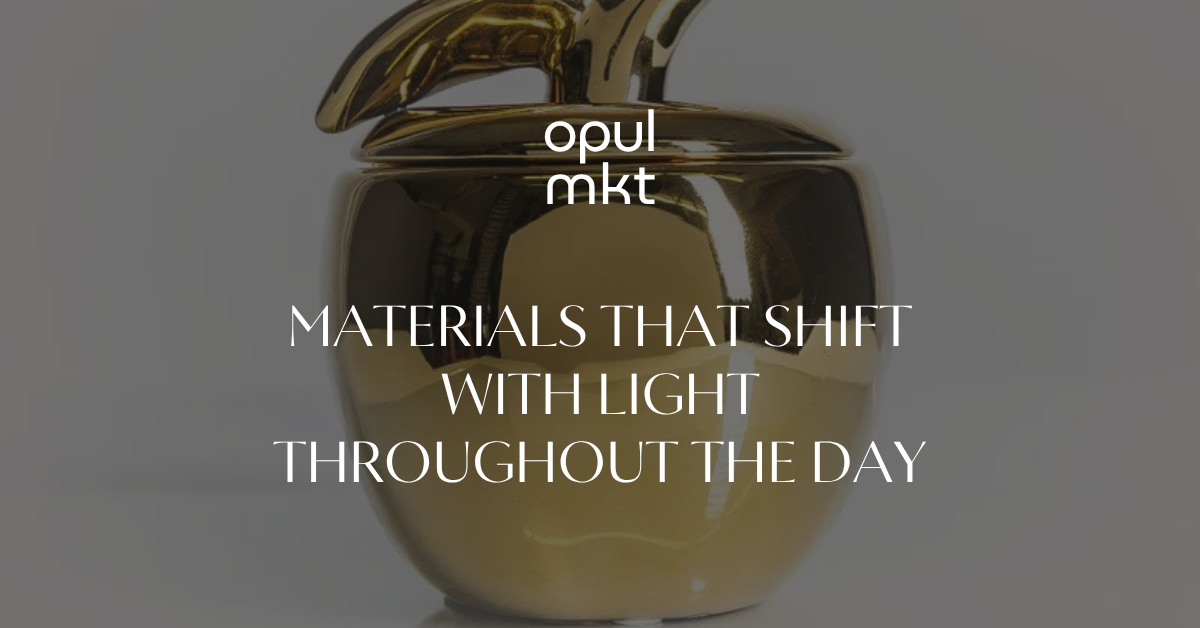
Unlacquered brass, aged bronze, and raw iron develop patina rather than maintaining a static finish. The piece that arrives at specification is not the final version of itself — it is the starting point. Over months and years, it develops the particular character of the room it inhabits, the hands that touch it, the light that falls on it. This trajectory is the opposite of conventional luxury. It is better than it was.
Statement lighting in unlacquered brass, aged metals, and organic forms is available through Opul Mkt's lighting collection — fixtures that improve rather than age out.
Sample dispatch is available across all material categories through the Opul Mkt trade programme. For a Wabi-Sabi brief, the material must be assessed in the light and context of the room it will enter — not from a screen or showroom.
04 — The Palette — Colour That Recedes
Colour in a Wabi-Sabi interior is not used to make a statement. It is used to create the conditions in which the materials can make their own. The palette is muted, earthy, and tonally consistent — chosen for its calming and grounding effect, not its visual excitement. The room should feel as if it emerged from the landscape rather than being imposed upon it.
Colour Specification Principles for the Wabi-Sabi Brief
- Warm Neutrals Over Cool Ones The Wabi-Sabi palette tends toward warmth — cream rather than white, warm grey rather than cool grey, stone rather than concrete. Cool palettes can produce the visual restraint of Wabi-Sabi without its warmth. The distinction matters.
- Muted Rather Than Saturated Earthy accents — sage, terracotta, dusty burgundy — are introduced in their dustiest, most receded versions. Not the sharp version of the colour, but the version that reads as if it has already been lived with for a decade.
- Tonal Consistency Across Surfaces A Wabi-Sabi room does not have one wall colour and a contrasting trim. It has a single tonal register across ceiling, wall, and architectural detail — sometimes called colour drenching — that allows material texture to differentiate surfaces rather than paint colour.
- Colour Drawn from the Materials Themselves The palette should feel as if it was derived from the materials the room contains — the grey of the stone, the warm brown of the timber, the cream of the linen. Not imposed upon them from outside.
05 — Simplicity With Substance — The Editing Decision
Wabi-Sabi loves simplicity but not emptiness. The discipline it requires of the designer is not the discipline of minimalism — of reduction for its own sake — but the discipline of curation: the willingness to include only what is genuinely necessary, in forms that feel grounded, textured, and alive. Every piece in a Wabi-Sabi room has been chosen because it belongs. Nothing has been added for visual completeness or to fill a perceived gap in the composition.
This is, in practice, the hardest thing to specify correctly. The temptation in any brief is to resolve the room — to add until it feels finished. Wabi-Sabi asks the opposite: to remove until nothing that is not essential remains, and then to resist the pressure to add it back. A room that contains twenty objects of genuine quality and appropriate scale will always outperform a room that contains forty objects of which only twenty are genuinely necessary. The client who says the room "feels right" is almost always responding to the quality of the editing, not the quantity of the collection.
Negative space in a Wabi-Sabi interior is not the absence of design. It is a design decision. The wall that is left bare gives the piece that hangs on it its full compositional weight. The shelf that holds three objects allows each of them to be read as specific. The corner that contains nothing allows the light in that corner to become visible.
Negative space is the frame. The designer who understands this does not ask what to add. They ask what to remove.
The Editing Checklist
- Remove the Decorative Layer First Before assessing what to keep, remove everything that is not performing a compositional function. Whatever feels like it is completing the room rather than belonging to it should be considered for removal.
- One Hero Object Per Zone Each zone of the room should have one piece that carries visual weight. Everything else supports it. If two pieces are competing for the same compositional role, one of them should be removed or relocated.
- Let Materials Be the Decoration In a room where the materials are genuinely good — a textured plaster wall, a hand-knotted rug, a solid timber table — the materials provide all the visual complexity the room requires. Additional decorative objects should augment, not supplement, this material richness.
- Resist Symmetry Wabi-Sabi arrangements are not symmetrical. A single vase rather than a pair. One book on a surface rather than a stack. The slight asymmetry of an arrangement that has not been forced into balance is what makes it feel inhabited rather than styled.
06 — Specifying the Wabi-Sabi Brief at Opul Mkt
The Wabi-Sabi brief requires a sourcing platform that understands the difference between materials that look natural and materials that are. Between handcraft that was genuinely performed and the simulation of it. Between imperfection that is authentic — the product of a specific making process with a specific material — and imperfection that has been manufactured to appear so.
Opul Mkt curates makers whose work meets the Wabi-Sabi standard at the material and craft level, not merely at the visual one. Every piece in the collection is documented with the construction method, material sourcing, finish treatment, and surface characteristics that allow a designer to assess its genuine quality — and to specify it with the confidence that what arrives will perform as the brief requires.
- Natural Material Documentation Material composition, finish treatment, and surface variation range documented per maker — including the characteristics that constitute the piece's imperfection: grain variation, glaze irregularity, weave inconsistency, patina trajectory.
- Handcraft Provenance Where a piece is hand-knotted, handthrown, hand-finished, or handmade in any material sense, this is documented — because for a Wabi-Sabi specification, the making process is as relevant as the finished object.
- Sample Dispatch Capability For a brief that asks you to assess texture, surface variation, and the feel of a material under the room's actual light conditions, sample dispatch is not a convenience. It is the specification process. Available across all material categories.
- Trade Consultation on Wabi-Sabi Briefs Project-specific guidance on which makers, materials, and finishes will deliver the genuine Wabi-Sabi standard — not the visual simulation of it. Available through the trade programme before any order is placed.
- Customisation Parameters Confirmed Upfront For pieces where dimension, finish, or material can be adjusted to the specific room brief, these parameters are documented before engagement — allowing the specification to fit the room rather than the room being adjusted to fit the specification.
Explore the Wabi-Sabi Brief at Opul Mkt
Specify the Wabi-Sabi Brief with Confidence
Apply for trade access for sample dispatch and project consultation on Wabi-Sabi specifications.
Share this guide with clients who say they want it to feel real — not like a magazine.
Imperfection is not a flaw in the specification. It is the specification.


Leave a comment
This site is protected by hCaptcha and the hCaptcha Privacy Policy and Terms of Service apply.