
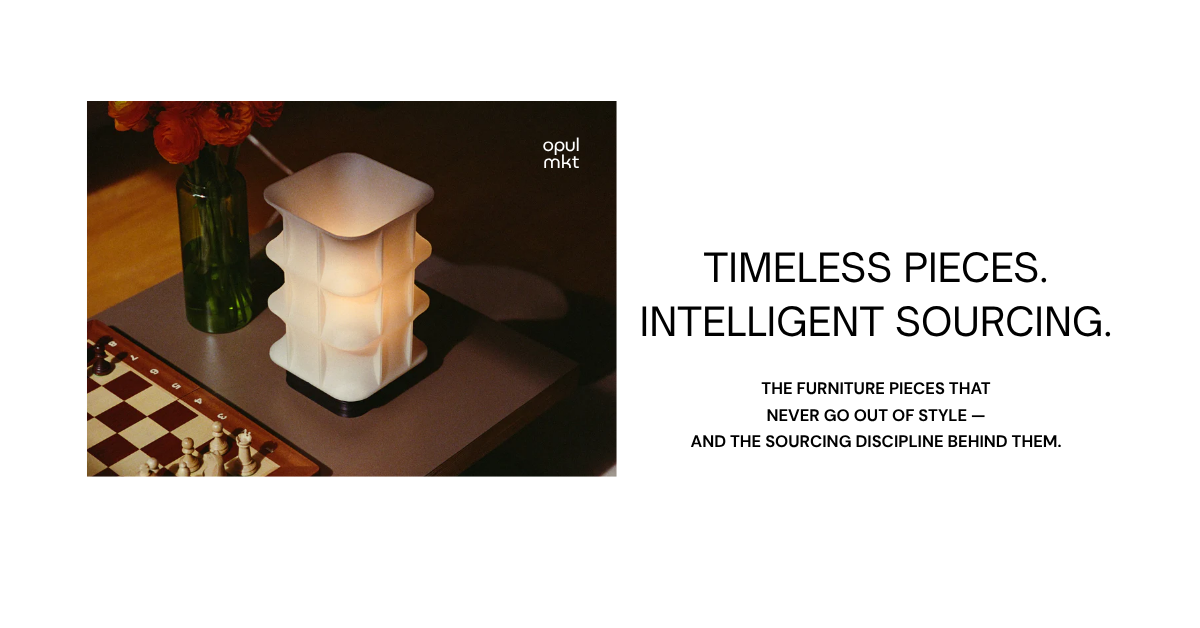
Iconic, enduring, never negotiable. The furniture pieces that have survived every design era are not the ones that photograph well in the moment — they are the ones built from the right materials, with the right construction, sourced through the right process. This guide covers both.
"The pieces that outlast every trend share one quality: they were chosen with full knowledge of what they were made from and how they would age."
01 — What Makes Furniture Truly Timeless
Timeless furniture is not simply furniture that has been around for a long time. It is furniture that continues to function as a compositional anchor regardless of the aesthetic direction of the room around it — pieces whose formal qualities, material depth, and proportional intelligence make them as relevant in a contemporary interior as they were when first designed.
Solid hardwood, natural stone, hand-stitched leather, hand-spun wool — materials that age into character rather than declining into fatigue.
Designed at the right scale for the human body and the rooms it inhabits — not optimised for the showroom or the product photograph.
Dovetail joints, solid frames, eight-way hand-tied springing — the construction methods that make a piece worth inheriting.
The Material Foundation
The materials from which a piece is made determine not only its longevity but its trajectory. Solid walnut, oiled with natural hardwax, deepens in colour and character over decades. An upholstered piece in top-grain leather develops a patina that a synthetic alternative can never replicate. A hand-knotted wool rug becomes more itself with use — the pile settles, the dyes soften, the weave acquires a depth that a machine-made alternative is incapable of achieving.
This is the distinction that matters to the design professional: the difference between materials that age into value and materials that decline into replacement. Specifying with material knowledge — not just visual preference — is what separates a timeless choice from a trend-aligned one.
Every piece in the Opul Mkt furniture collection is documented with material composition, finish treatment, and construction method — the specification depth required to make a timeless choice, not just an aesthetic one.
02 — The Twelve Pieces — A Designer's Permanent Portfolio
 These are the furniture categories that every serious design practice returns to across projects — pieces whose formal authority, material depth, and proportional intelligence make them compositionally essential regardless of brief, client, or era.
Deep-seated, fully upholstered, built for occupation. The form has not changed because it cannot be improved. Specify in top-grain leather or heavyweight linen — materials that develop character with use.
View at Opul Mkt →Button-tufted, roll-armed, historically rooted. Functions in both traditional and contemporary contexts with equal authority. The silhouette alone carries visual weight without competing with the room.
View at Opul Mkt →Clean-lined, architectural, proportionally resolved. The Parsons form is as neutral as a dining table can be — it never competes with the chairs, the rug, or the room. Specify in solid hardwood or stone.
View at Opul Mkt →Architectural presence in a domestic scale. The high back creates a visual anchor that a lounge chair cannot. Pivotal in bedrooms, reading rooms, and any space where a point of occupation needs to be defined.
View at Opul Mkt →The bed is the architectural event of the bedroom. A well-specified bed — upholstered headboard, solid frame, correct scale — renders every other decision in the room subordinate and legible at once.
View at Opul Mkt →The workhorse of the transitional space — entry, hallway, behind a sofa. In solid hardwood or stone, a console introduces material depth at a scale that does not dominate. Its surface invites the curation layer.
View at Opul Mkt →Storage with horizontal authority. In solid walnut or oak, a well-proportioned credenza anchors a dining room or living room wall with the material weight of furniture rather than the visual neutrality of built-ins.
View at Opul Mkt →Versatile, proportionally adaptable, materially expressive. At the foot of a bed, at a dining table, in an entry — the bench occupies space without committing it. Natural linen or bouclé reads across every aesthetic direction.
View at Opul Mkt →Material authority at room centre. A stone-top coffee table introduces geological permanence into the living room composition. Travertine, honed marble, or sintered stone — each ages differently, each ages well.
View at Opul Mkt →The only horizontal hero piece — it defines zone, anchors furniture, introduces colour from the ground up. At correct scale, it becomes the room's structural foundation. It improves for decades.
View at Opul Mkt →Light, scale, and formal interest in a single piece. An arched or sculptural mirror introduces curves at wall scale without structural intervention. In a dark room it multiplies light; in any room it multiplies perceived space.
View at Opul Mkt →The only piece that occupies every eye level simultaneously. A sculptural pendant defines zone, draws the eye upward, and sets the material register for everything beneath it. Scale correctly against ceiling height — it cannot be underdone.
View at Opul Mkt →03 — Procurement — The Hidden Variable
 Procurement and sourcing are not the most glamorous part of interior design practice. They are the most consequential. A correct specification made through an unreliable procurement process produces a worse outcome than a slightly imperfect specification made through a reliable one. The piece that arrives damaged, late, or wrong undermines the entire composition it was meant to anchor — regardless of how correct the specification was on paper.
The Core Procurement Principle
Before you begin sourcing materials or contacting vendors, you need a solid understanding of your client's needs, lifestyle, and budget. Style preferences, functional requirements, and financial constraints all shape which pieces are appropriate — and what sourcing approach will deliver them reliably.
What a Professional Procurement Process Requires
- A defined client brief — style direction, functional requirements, room dimensions, finish direction, and budget tier confirmed before any sourcing begins
- Material specifications upfront — wood species and grade, stone type and finish, textile fibre content and durability rating — not category descriptions
- Lead time confirmed at order — not estimated, not aspirational. Lead times are project constraints; a missed one cascades across the entire installation schedule
- A purchase order for every item — documenting item description, quantity, price, finish spec, dimension, and delivery instructions as a binding agreement
- A procurement log — tracking order status, vendor contact, lead time, and delivery window for every item across every project simultaneously
Opul Mkt's trade programme provides project-specific guidance on material selection, customisation feasibility, and specification support before any formal order is placed.
04 — Choosing the Right Supplier
Every supplier a designer adds to their sourcing portfolio is a professional commitment. When a product arrives wrong, late, or damaged, the designer — not the supplier — bears the reputational cost with their client. This is why experienced designers are conservative about adding new vendors: the evaluation that happens before the first order is the most important quality control step in the entire process.
The Six Signals Designers Read Before the First Order
- Visual Standard Does the photography reflect the actual quality of the product, or aspirational styling? Inconsistency between photography and specification is a warning signal.
- Specification Depth Are material, construction, finish, dimension tolerance, and care requirements documented? Or does the product description rely on adjectives like "premium" that substitute for information?
- Lead Time Honesty Does the platform commit to real production lead times, or quote aspirational times that are routinely missed? Ask what happens when lead times change — the answer reveals the supplier's process.
- Customisation Clarity What can actually be changed — finish, dimension, material, upholstery — and what cannot? A platform that presents everything as customisable without specifying the parameters wastes designer time.
- Trade Protection Does the supplier sell the same products to your clients at retail? If so, the designer's access advantage — and the professional value of their specification — is directly undermined.
- Frame Construction and Material Ratings Request technical specs. Look at frame construction, joinery, upholstery details, and material ratings before committing to a specification your client will live with for a decade.
"A supplier who performs impeccably on a first order earns a level of loyalty that is difficult to displace. The luxury sourcing market is smaller than it appears. Reputation travels fast in both directions."
05 — Managing the Full Delivery Cycle
A sourcing relationship is only as strong as its execution across the full delivery cycle. The design and selection phase is where creative decisions are made. The procurement and delivery phase is where professional reputations are won or lost. Designers who understand what reliability looks like at each stage — and who choose suppliers who demonstrate it — protect their client relationships and their own practice.
-
At Order Placement
Written confirmation of all specifications — not just SKU and quantity — so there is no ambiguity about what was ordered. Accurate lead time commitment at the point of order. A named point of contact for the order, not a ticket number in a general queue.
-
During Production
Proactive communication at production milestones — particularly for custom or long-lead items. Early warning of any schedule changes, with sufficient lead time for the designer to manage client expectations. Maintain a procurement log to monitor order statuses.
-
At Delivery
Accurate dispatch notification with a realistic delivery window. Upon delivery, thoroughly inspect each item for damage, verify dimensions, and confirm that quality meets specifications. Immediate inspection allows for prompt resolution of any issues.
-
When Things Go Wrong
Problems occur in every supply chain. The question is not whether something will go wrong — it is how the supplier responds when it does. A supplier who takes ownership, communicates proactively, and resolves quickly earns more trust than one who never acknowledges the problem.
06 — Quality Control in Practice
The piece that makes a room work is the piece that continues to make it work a year after installation — when the photography is done, the client has moved in, and the space is being lived in rather than photographed. Quality control in furniture specification is not a post-delivery activity. It begins at the specification stage.
Solid hardwood over engineered alternatives. Dovetail or mortise-and-tenon joinery over stapled or glued construction. Kiln-dried timber to prevent warping over time.
Martindale abrasion rating appropriate to the use. Natural fibre — linen, wool, top-grain leather — over synthetic for pieces in daily use. FR rating confirmed for commercial or hospitality specifications.
Honed stone for high-use surfaces; polished for lower-traffic applications. Oil or wax finish for timber that will develop patina; sealed finish where maintenance is a concern.
Not showroom context. Ceiling height vs pendant diameter. Wall clearance for rugs. Passage clearance around dining tables.
Annual sealing for natural stone, specialist cleaning for hand-knotted wool, conditioning schedule for top-grain leather. The client who understands maintenance is the client who does not blame the designer when a piece shows wear.
Every maker on the Opul Mkt platform is assessed for specification infrastructure: material composition, surface treatment and durability, maintenance requirements, and customisation options.
07 — Why Opul Mkt — Built for This Brief
 Timeless specification and intelligent procurement require a sourcing platform that provides the right information at two resolution levels simultaneously. For the hero pieces — the twelve categories that define a room's compositional authority — designers need deep specification documentation: material, finish, scale range, durability, customisation options, sample capability, and lead time. For the supporting layers, they need efficient comparative access without opening multiple accounts or chasing multiple supplier contacts.
- Pre-Engagement Clarity Complete material specifications, dimensional accuracy, honest lead times, and defined customisation parameters available upfront — before any enquiry is required.
- Advisory Intelligence Project consultation on material selection, customisation feasibility, and specification support — a sourcing partner, not just a catalogue.
- Trade-Only Access Products and customisation options not available through retail channels, preserving the designer's access advantage and the professional value of their specification.
- Curated Maker Network Artisan studios, material specialists, and independent makers selected for design quality, craft integrity, and execution reliability — across furniture, lighting, rugs, art, textiles, and objects.
- Execution Reliability Order documentation, production communication, and issue resolution processes designed to meet the standard that professional designers require.
Source the pieces that last. Specify with intelligence. The twelve pieces. The process that delivers them.
Built for the Design Professional
Apply for trade access to unlock project-specific sourcing consultation, customisation support, and specification guidance.
Browse the full collection — every piece documented with the material, finish, and construction detail you need to specify with confidence.


Leave a comment
This site is protected by hCaptcha and the hCaptcha Privacy Policy and Terms of Service apply.