
There is a quality in certain interiors that photographs cannot capture and trend reports cannot predict — the quality of rooms that feel genuinely inhabited, that have depth, that reward sustained attention, that seem to improve with the life being lived in them. This quality does not emerge from expensive purchases or impeccable styling. It emerges from the intelligence of the materials.
Raw materials — stone extracted from quarries, textiles woven from plant and animal fibres, timber felled and cured, metals worked by hand — carry within them a kind of memory. The memory of the geological processes that formed them, the generations of craft knowledge that learned to work with them, and the particular way each one responds to light, touch, and time. When these materials are specified with genuine intelligence and allowed to do what they do, they produce interiors that feel irreplaceable: specific, alive, and unmistakably real.
"True luxury reveals itself gradually. It exists in the weight of a door handle, the way afternoon light catches the irregular surface of a hand-printed fabric, the subtle variations within what appears uniform from a distance."
Part I: The Surface Problem in Contemporary Luxury Design
The contemporary luxury interior design market has a surface problem. Spaces are composed for the camera angle, the social media post, the listing photograph. Materials are selected for visual punch — the dramatic vein pattern of a slab, the high-gloss finish of a lacquered cabinet, the immediately striking quality of a statement fixture. The result can be spectacular on first encounter and disappointing on the second.
What these spaces lack is not more investment or better taste. What they lack is depth — the quality that emerges from materials with enough in them to sustain prolonged attention. A hand-printed velvet that shifts in tone as you move around it. A marble surface whose veining contains geological time. A woven rug whose tonal variation rewards closer inspection. These are not dramatic. They are inexhaustible.
The Photography Problem
The dominance of photography as the primary medium through which interiors are evaluated has systematically disadvantaged the materials that cannot easily be photographed. The subtle pile variation of a hand-knotted rug. The optical depth of velvet that changes character with viewing angle. The atmospheric shift of limewash wall finish as light moves through a day. The patina of unlacquered brass as it oxidises over months and years. None of these qualities photograph well. All of them produce the sustained sensory interest that makes a room genuinely inhabitable over years rather than seasons.
Designers who understand this discrepancy specify differently from those who do not. They invest in the materials that cannot be staged — the ones that reveal themselves through sustained habitation rather than through a morning's worth of photography. These are, almost without exception, the raw materials: stone, natural fibre, solid wood, hand-worked metal, handmade textile.
Design vs. Styling
Styling arranges elements according to current preferences. Design integrates materials, forms, and functions into coherent wholes that transcend their moment of creation. Styled rooms age as tastes shift. Designed spaces mature, developing character through habitation.
The materials that enable this maturation are the ones with enough inherent complexity to improve rather than simply endure. Stone gains patina. Wood deepens in colour. Quality textiles soften while maintaining their structure, developing a particular character through years of use. Spaces built from these materials feel alive and specific to their occupants — not extracted from a trend report, but grown from the accumulated intelligence of sustained making.
Part II: Material Memory — What Raw Materials Carry
 Every raw material carries within it accumulated intelligence — not metaphorically but practically. Centuries of craft tradition have refined the understanding of how each material behaves: how marble veins form and where they yield to the blade, how linen fibre responds to tension and washing, how oak grain orientates to determine where a board will split, how unlacquered brass will develop its patina over the particular conditions of a specific room.
This intelligence cannot be codified into industrial processes. It lives in the hands and eyes of makers who learned from predecessors who learned from their own predecessors — each generation refining the practice in response to what the material actually does rather than what it should do according to specification. When you specify a piece made by a maker with this depth of practice, you are not simply purchasing an object. You are incorporating centuries of material knowledge into your project.
Stone: Geological Time Made Interior
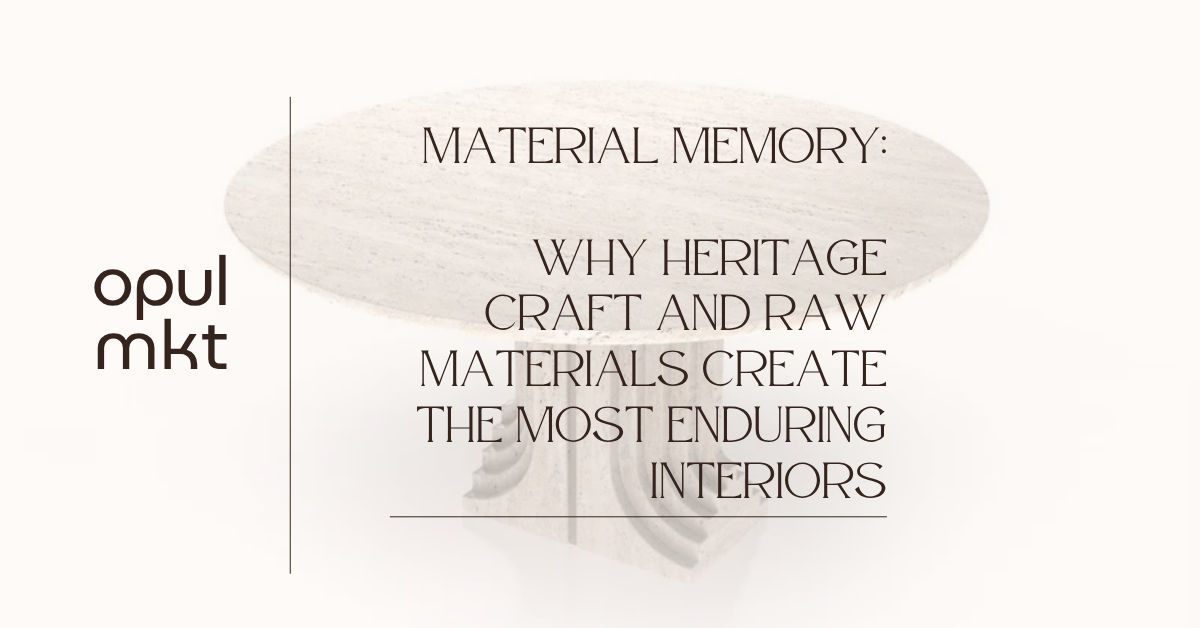
 Marble, travertine, limestone, and quartzite are among the few materials that bring geological time into an interior. Each block of stone is unique — the product of specific mineral conditions over millions of years, extracted from a particular place, cut to reveal a section through that history. The veining pattern of a Calacatta marble, the fossilised shells in a Jura limestone, the travertine voids that fill with light differently depending on whether the stone is honed or polished — these are not design decisions. They are geological events, made interior.
The artisans who work natural stone furniture understand this. At studios like Monitillo 1980, founded in the Murge region of Apulia over forty years ago, the practice begins with the search for the stone itself — for blocks with the particular vein characteristics, colour registers, and structural integrity that a specific design requires. Working a single large marble table from one block is not simply a feat of engineering. It is an act of material respect: honouring a single geological event as a single designed object, with its full veining narrative intact.
- What natural stone does that synthetic alternatives cannot
- Shifts in tone and depth as light moves through the day — morning coolness, afternoon warmth, evening shadow — in ways that engineered surfaces cannot replicate
- Develops a surface patina with use that deepens the material rather than showing wear — honed travertine becomes smoother and richer, not more worn
- Carries inherent tonal variation within a single slab that creates visual depth at every scale of attention — from across the room to inches away
- Connects the room to a specific geography and geological history — a material that could only have come from one place in the world
Natural stone furniture and objects — in marble, travertine, and mineral finishes — are available through the Opul Mkt furniture collection and décor collection — pieces from makers who work stone with the geological intelligence it deserves.
Textile: The Connective Tissue of Interior Space
If stone is the most ancient of interior materials, textile is the most intimate. Fabrics define how we experience rooms perhaps more than any other element — they absorb sound, modulate light, and provide the tactile interface between inhabitants and space. The Venetian tradition understood textiles not as decoration but as fundamental architecture rendered in fibre. The palazzo interiors that still feel alive centuries after their creation employed fabrics to define zones within larger rooms, modulate acoustics, and control light.
Consider velvet — a material that has graced interiors for centuries precisely because its structure creates optical effects that machines still cannot replicate. The pile catches light differently depending on viewing angle, creating subtle shifts in colour and depth that transform as you move through a room. Quality velvet ages beautifully, developing character rather than deterioration. The crush marks in a well-used velvet cushion are not signs of wear but evidence of life.
- Handwoven Wool and Silk Pile variation and tonal shift that emerge from the irregularity of hand process — impossible in machine weaving.
- Hand-Printed Cotton and Linen Colour layering achieved through repeated printing decisions refined over generations, producing depth that single-pass printing cannot achieve.
- Quality Velvet Optical variation with viewing angle that creates the impression of a material that changes character as the day progresses.
- Natural Linen Wrinkle behaviour that demonstrates fibre resilience; softens with washing while maintaining fundamental structure; decades of performance where synthetic alternatives fail.
Handwoven rugs and natural fibre textiles that carry the material intelligence of genuine craft are available through Opul Mkt's rug collection and the textiles collection — pieces from artisan makers who understand that fabric is not decoration but spatial architecture.
Timber: Growth Rings as Design Language
Solid hardwood carries the record of its growth within its grain. The tight growth rings of slow-grown oak tell a different story from the wide rings of fast-grown timber; the grain direction determines the material's structural behaviour; the knot patterns record the history of branches now long gone. These are not defects to be minimised. They are the material's biography, and in the hands of a maker who understands them, they become design language.
- What solid hardwood does that engineered alternatives cannot
- Changes with the seasons — expanding and contracting in response to humidity — in a way that requires understanding but produces a surface that is genuinely alive
- Develops grain depth and colour over years of use that sealed, veneered alternatives never achieve
- Can be refinished, re-oiled, and restored to original specification — it has a restoration future that MDF-core alternatives do not
- An oiled walnut surface maintained with natural oils over two decades will be a more beautiful object than it was when new
Browse solid hardwood furniture at Opul Mkt — pieces from makers who specify for grain character, honest finish treatments, and the temporal behaviour that distinguishes investment-grade timber from its engineered alternatives.
Metal: Patina as Evidence of Quality
 Unlacquered brass, bronze, and copper are among the most temporally dynamic materials available to the interior designer — materials whose most interesting state is not their initial condition but the one they develop through years of use and exposure. Unlacquered brass oxidises in patterns determined by the specific atmospheric conditions of the room it inhabits: the humidity, the light exposure, the frequency of touch. No two pieces develop identical patinas. Each one becomes, over time, a record of its particular history.
- What unlacquered metal does that lacquered alternatives cannot
- Develops a patina determined by the specific atmospheric conditions of its room — humidity, light exposure, frequency of touch — that makes every piece unique over time
- Becomes more itself with age: each stage of oxidation is evidence of the quality of the base metal and the honesty of the surface treatment
- Avoids the failure mode of lacquered alternatives — which maintain a static appearance until they begin to show maintained-to-failure wear
- Produces the warm, varied tonal quality that static coatings suppress — a surface that looks different at morning, afternoon, and evening
Statement lighting in aged metals and natural materials — handblown glass, unlacquered brass, organic forms — selected for their material depth as much as their light quality.
Part III: Heritage Craft — Living Intelligence, Not Historical Reference
Heritage in interior design is frequently misunderstood as a decorating style — a visual reference to historical periods, an accumulation of antique objects, a preference for traditional silhouettes. This is a profound misreading of what heritage actually offers.
Heritage, properly understood, is the distilled wisdom of sustained practice. It is the accumulated knowledge of generations of makers refining their understanding of how materials behave, how spaces are inhabited, how light transforms surfaces, how form and proportion create or destroy a sense of ease in a room. This knowledge is not archived in museums or referenced in design histories. It exists in the hands, eyes, and judgement of makers who learned it through direct transmission from practitioners who learned it before them.
The Unbroken Lineage
At Fortuny's factory in Venice, the machinery designed by Mariano Fortuny over a century ago is still operated by artisans who learned their craft from predecessors in an unbroken lineage. This is not museum preservation — it is active practice. The printing formulas have been refined through generations. The colour combinations have been tested against the specific qualities of Venetian light over decades of accumulated observation. The intelligence exists in the making.
The parallel at Monitillo 1980 in Apulia is the same: a father's practice in construction and local marble, transformed by his sons into an international design vision through the integration of advanced technology without the abandonment of hand finishing. The CNC cutting and robotic contouring open new design possibilities. The hand finishing preserves the authenticity and individuality that makes each piece an object rather than a product. Neither would be sufficient alone.
Why Heritage Craft Produces Surfaces Machines Cannot Replicate
Optimises for consistency — every piece identical within specified tolerances. Produces surfaces that are predictable, reproducible, and photographically legible. Exhausts their visual interest in the first encounter.
Optimises for responsiveness — every piece correct in response to the particular conditions of that material on that day. The slight variation, the micro-texture, the pile height shift: not defects but evidence of responsive intelligence applied to material.
The slight variation in pigment density across a hand-printed fabric. The micro-textures in handblown glass that catch light in patterns moulded alternatives cannot achieve. The pile height variation across a hand-knotted rug that creates the tonal shift visible when you look across the surface. The grain character of a solid wood table whose maker selected it for the specific visual quality of this particular tree. These variations are not defects. They are precisely what makes these surfaces inexhaustible to look at.
Quiet Confidence as the Marker of Heritage Quality
The current fascination with quiet luxury represents a partial recognition of what heritage craft has always understood: true luxury need not announce itself. Restraint signals confidence. Quality reveals itself to those who know how to look.
In a room composed from materials with genuine depth, there is no need for visual drama. The surfaces themselves provide the interest — the shift of velvet pile in changing light, the movement of grain in an oiled timber surface, the tonal variation of a stone whose veining has been placed with care. These are not quiet in the sense of being absent or neutral. They are quiet in the sense of being deeply occupied with their own material reality, confident enough not to need to perform.
Part IV: Applying Material Intelligence — Room by Room
Understanding the principle of material memory and heritage craft is the beginning. Applying it — knowing which materials to prioritise in which contexts, how to combine them, and where to source the pieces that carry genuine craft intelligence — is the design practice.
Fewer stone surfaces, each chosen for the specific tonal and vein character that serves the room's palette. A honed marble coffee table anchors a seating arrangement with a weight that no other material can replicate. A marble console in a hotel lobby communicates material authority before a single other design decision registers. Explore stone furniture →
In any room, the textile layer has more influence on the lived experience than the furniture layer. A handwoven wool rug changes acoustic quality, provides thermal comfort, defines the seating zone visually, and provides — in its tonal variation — the most sustained source of visual interest in the space. No piece of furniture does as many things simultaneously.
A lighting fixture in natural materials operates simultaneously as a source of light and as a material object with its own temporal behaviour. The handblown glass pendant that catches light differently depending on where you stand. The unlacquered brass sconce that develops patina in the specific atmospheric conditions of the kitchen. Explore natural material lighting →
In a room composed primarily from natural materials, art and decorative objects serve as material punctuation — pieces that introduce a different register of making. A hand-thrown ceramic. A sculptural marble object. An original artwork. Not expensive, but genuine: made by a specific person with specific material knowledge. Explore original art →
For designers building a textile-led approach to material specification, Opul Mkt's rug collection and textiles collection offer handwoven and naturally dyed pieces from makers who understand fabric as spatial architecture.
Curated art and hand-made decorative objects from independent makers worldwide are available through Opul Mkt's art collection and the décor collection — pieces selected for material intelligence and craft depth.
Part V: Sourcing Material Intelligence — What to Look For
The practical challenge of specifying for material depth is sourcing. The makers who possess genuine craft knowledge and work with authentic natural materials are not found through standard trade catalogues, which optimise for consistency, volume pricing, and the kind of visual appeal that photographs well. They are found through curated networks built around the qualities that matter: material authenticity, craft depth, and the provenance transparency that gives a piece its full meaning.
The Questions That Identify Genuine Material Quality
- Where does this material come from, specifically — quarry, mill, workshop, field?
- Who made this, and what is their training and practice lineage?
- What does this material do with age — and how do I know?
- Can I see examples of this piece at five years and ten years of age?
- Is there documentation of the making process that supports future restoration?
- What finish treatment has been applied, and does it allow the material to breathe and develop?
A maker or platform that cannot answer these questions with specificity and confidence is not selling material intelligence. One that answers them with depth and evidence almost certainly is.
Heritage as Practical Resource, Not Historical Reference
The most important reframing for designers working with this material philosophy is the understanding that heritage craft is not a stylistic choice. It is a practical resource. The accumulated intelligence of generations of makers refining their practice offers solutions to design problems that recur across eras — because they stem from fundamental aspects of how we experience interior space: how light transforms surfaces, how acoustic quality affects emotional tone, how tactile richness changes the experience of inhabiting a room.
"Those seeking to create interiors of lasting value might begin by reconsidering what luxury means — not the trendiest materials or most exclusive brands, but elements chosen for their capacity to sustain interest and improve with age."
Opul Mkt — Curated for Material Depth
 Every maker in the Opul Mkt network is selected for the material intelligence this guide describes: the depth of craft knowledge, material authenticity, and temporal behaviour that distinguishes pieces worth specifying from pieces worth photographing.
Raw materials feel refined when they are worked by makers who understand them — not tamed or contained, but allowed to do what they do. Stone that carries its quarry's geology into a living room. Velvet that shifts tone as you move around it. Timber that deepens with years of honest use. These are not decorative choices. They are design decisions that produce rooms worthy of the life being lived in them.
Specify for Material Depth on Your Next Project
Save this guide for material selection planning on residential and hospitality projects.
Share with clients who want to understand why natural materials justify the investment.
Share with studio teams briefing makers for material-led design concepts.


Leave a comment
This site is protected by hCaptcha and the hCaptcha Privacy Policy and Terms of Service apply.