
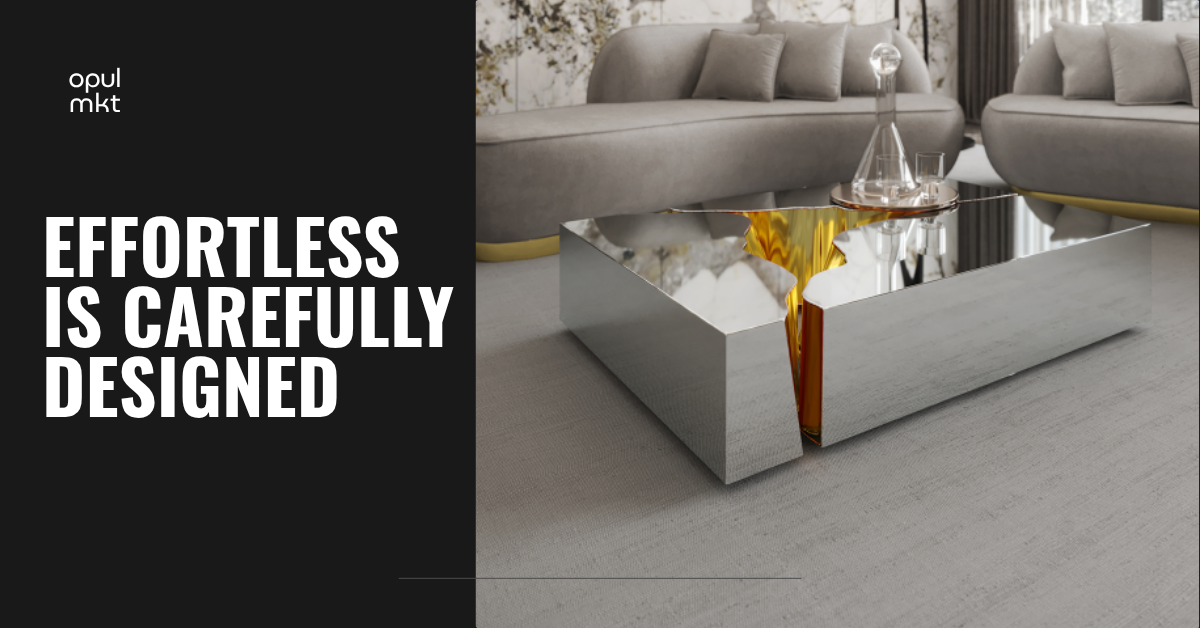
How relaxed luxury interiors are actually built — one considered decision at a time
 There's a particular kind of room that feels like it happened by accident: light falling just right, furniture that seems to have always belonged, nothing trying too hard. This is the promise of relaxed luxury interiors and lived-in luxury — spaces that read as effortless. In practice, that effortlessness is the result of hundreds of deliberate choices about scale, material, sourcing, and restraint. This guide breaks down what actually goes into simple high-end interiors and how to bring that sensibility into your own space.
What "Effortless" Really Means in Interior Design
Effortless design isn't the absence of effort — it's the absence of visible effort. The goal is a space that feels seamless and organic, where every piece earns its place through both function and feeling. Done well, it turns a room into a quiet luxury retreat: calm enough for daily life, considered enough for entertaining.
Two ideas sit at the center of this approach:
- Organic silhouettes — furniture and objects with natural, unforced forms rather than rigid or trend-driven shapes
- Bespoke procurement — working directly with designers and artisans to source or create pieces tailored to a specific space, rather than defaulting to mass-market options. Learn more about our bespoke procurement services
Together, these create rooms where nothing feels generic, because very little of it is.
The Framework: Reading a Space Before Furnishing It
Effortless interiors start with observation, not shopping. Before selecting a single piece, look closely at:
- Architecture — the bones of the room, including ceiling height, sightlines, and structural features
- Lighting — both the quality of natural light and how artificial lighting will layer in after dark
- Materials — what's already present in floors, walls, and trim, since new pieces need to work with these, not against them
A room flooded with natural light generally benefits from light-colored materials and minimal window treatments that let the light do the work. A darker room, by contrast, often calls for warm lighting and richer materials — deeper woods, saturated textiles — to create a sense of coziness rather than gloom. The materials and light in a space should dictate the palette, not the other way around.
Editing Is a Design Skill, Not a Compromise
The instinct to fill a room is one of the fastest ways to undercut an effortless look. Real editing means choosing a small number of high-quality pieces over a large number of adequate ones, then paying close attention to:
- Scale — how a piece's size relates to the room around it
- Proportion — how furniture groupings relate to each other
- Visual flow — how the eye moves through the space from one focal point to the next
A room with fewer, better pieces almost always reads as more luxurious than one that's fully furnished but visually crowded.
Putting It Into Practice
Designers tend to work from one of two starting points when building an effortless interior.
Start neutral, then punctuate. Establish a quiet, neutral background — walls, flooring, larger upholstery — and then introduce statement pieces that carry the room's personality: fine art, sculpture, a handcrafted rug, or a single piece of bespoke furniture. The neutral base keeps the statement pieces legible instead of competing with their surroundings.
Build through texture. Instead of layering in color or pattern, layer in material contrast: the roughness of a stone wall against the smoothness of a leather sofa, or the density of a plush area rug against the crispness of linen upholstery. This kind of textural depth is often what makes a neutral room feel rich rather than flat.
What Separates Curation From Shopping
The difference between a curated room and a furnished one usually comes down to intent. Considered selection means asking, for each piece: What's the story behind it? What craftsmanship went into making it? Does it create an actual emotional response, or does it just fill space?
This is also where sourcing decisions matter most. Choosing a piece made by a local or independent artisan over a mass-produced equivalent does two things at once — it gives the room something genuinely unique, and it supports more sustainable, small-batch production instead of volume manufacturing. Over time, these choices are what separate a space that looks put-together from one that actually is.
Frequently Asked Questions
Effortless design is an approach to interiors that prioritizes pieces which are both visually striking and genuinely functional, resulting in a space that feels seamless and organic rather than staged.
Begin by reading the space itself — its architecture, natural light, and existing materials — before choosing furniture or decor. Let those conditions guide your palette and material choices, then build outward from there.
Editing keeps a room from feeling cluttered or generic. A smaller number of well-chosen, high-quality pieces almost always creates a stronger, more luxurious impression than a fully furnished room with less intentional selections.
Weigh scale, proportion, and visual flow first, since a piece that's the wrong size will disrupt the room regardless of how beautiful it is on its own. Beyond that, look for pieces with a real story or craftsmanship behind them — that's usually what creates an emotional connection to the space.
Explore Related Design Directions
Ready to bring this approach into your own space? Explore our collections of luxury furniture, fine art, and decorative objects, or learn more about our bespoke procurement services and how we work directly with designers and artisans on custom pieces.
A few starting points for effortless rooms: wall art, handcrafted rugs, and decorative objects. For layered, warm lighting, browse our indoor lighting collection, including chandeliers and table lamps.
Visit our homepage to see the full range.


Leave a comment
This site is protected by hCaptcha and the hCaptcha Privacy Policy and Terms of Service apply.