
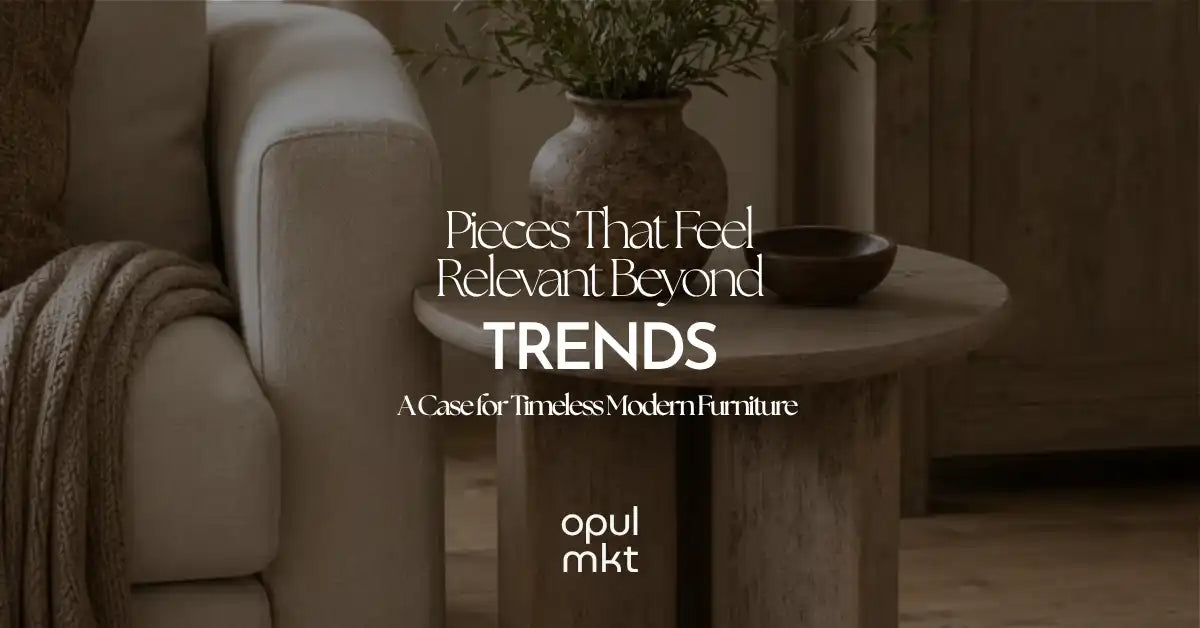
The most convincing interiors are rarely the ones that announce the year they were designed. They have a point of view, a disciplined material language, and enough visual generosity to absorb change. That is the distinction between collecting fashionable objects and specifying pieces with a longer cultural and practical life. As conversations around interior design trends 2027 move toward comfort, natural materials, hospitality, and emotional durability, the real question is not which look is next. It is which pieces will still feel intelligent when the mood shifts.
This is a guide to making that decision with confidence. We will examine proportion, material, construction, patina, flexibility, and context, then translate those ideas into choices for residences, hotels, offices, and public spaces. The aim is not to remove personality from a project. It is to make personality reside in the right places: in composition, art, texture, and use rather than in disposable visual signals.
Read the Moment Without Designing for a Moment
Trends are evidence, not instructions
The top interior trends current year can reveal meaningful shifts in how people want to live. A renewed appetite for tactile surfaces may reflect a desire for sensory calm. Softer seating may acknowledge longer evenings at home. Darker woods and aged metals may answer a fatigue with immaculate, frictionless spaces. These are useful observations, but they are not specifications.
A designer working on a Manhattan apartment, for example, might notice the current enthusiasm for brown upholstery and apply it everywhere. A stronger approach would be to ask what the color contributes: warmth, depth, or a useful counterpoint to daylight. Perhaps the answer is a tobacco leather lounge chair, while the larger sofa remains in a quiet oatmeal textile that can accommodate future art and rugs.
Separate atmosphere from silhouette
Some trends describe an atmosphere; others describe a recognizable shape. Atmosphere is usually more durable. A room can feel warm, intimate, and collected without relying on a particular boucle, scalloped edge, or viral chair profile. The silhouette needs a more rigorous test: does its geometry support the room, and will it remain comfortable and legible after the surrounding vocabulary changes?
In a boutique hotel lobby, a low, generously scaled sofa can express the current interest in residential comfort without looking like a residential sofa dropped into a commercial setting. Its relevance comes from proportion, upholstery performance, and the way it organizes circulation. Replace the rug or pendant in five years and the architectural logic still holds.
Trend awareness should sharpen a point of view, never substitute for one.
The Proportion Test for Modern Furniture That Won’t Date
Scale is the quietest form of longevity
Proportion often determines whether a piece feels enduring more decisively than its finish. A chair with a slightly generous seat, a table with a rational footprint, or a cabinet divided according to the objects it stores will continue to make sense as tastes evolve. By contrast, a distinctive piece can become dated when its scale is tied to a narrow room type or a short-lived planning habit.
For a living room, evaluate the relationship between seat height, coffee table height, and the primary circulation path. A sofa that is 36 to 40 inches deep may provide comfort without consuming the room, while a 44-inch-deep model may be better suited to a large lounge arrangement than a compact apartment. Leave approximately 14 to 18 inches between the front edge of seating and a coffee table, adjusting for the client’s movement patterns rather than treating the dimension as a rule.
Use a measured hierarchy
Enduring rooms usually contain a hierarchy of scale: one dominant anchor, several supporting pieces, and smaller elements that create rhythm. In a 12-by-18-foot sitting room, a 9-by-12-foot rug can establish the seating group more effectively than a collection of undersized accent rugs. In a hotel lounge, two substantial lounge chairs may define a conversation zone more clearly than six small chairs that interrupt sightlines.
Specify from the plan outward. Confirm elevator dimensions, door clearances, turning radii, baseboard conditions, and the final upholstery depth before approving a statement piece. A beautiful sectional that cannot navigate a 32-inch apartment doorway is not an investment; it is a logistics problem with excellent photography.
Material Honesty Makes a Piece Feel Older Than Its Date
Let surfaces show how they will live
Timeless modern furniture does not need to be austere. It needs materials whose behavior is understandable. Solid walnut will deepen in color; unlacquered brass will develop variation; full-grain leather will register touch; a hand-knotted wool rug will soften at the edges of its pattern. When the expected aging is attractive, the object gains a second life beyond its first impression.
Consider a dining table for a family residence. A highly reflective lacquer may look perfect at installation but demand constant management around fingerprints and small scratches. Oiled oak or walnut, specified with a durable commercial-grade topcoat when necessary, can accept the evidence of meals and gathering. In a private dining room used only occasionally, a more delicate finish may be justified because the use profile supports it.
Material choices with different forms of endurance
- Wool: resilient, naturally forgiving, and appropriate for high-traffic rugs and upholstery where warmth matters.
- Silk or viscose: luminous and refined, but best reserved for low-traffic areas, layered rugs, or decorative surfaces because crushing and moisture require care.
- Bronze: substantial, stable, and capable of a nuanced patina; a strong choice for hardware, bases, and lighting in hospitality settings.
- Brass: brighter and more graphic when polished, softer and more atmospheric when aged; confirm whether the finish is sealed before specifying it near moisture.
- Solid wood: repairable and materially rich, though it moves with humidity and requires appropriate construction details.
- Veneer: efficient and dimensionally stable for large panels; the quality depends on substrate, edge treatment, matching, and finish rather than on the word veneer alone.
In a gallery-like residence, a stone side table may provide the visual gravity a room needs, but a lighter wood table may be the better choice beside a deep sofa where daily flexibility matters. Material endurance is always a relationship between substance, use, and maintenance.
Warm Modern Interior Design Needs Restraint, Not Beige
Build warmth through contrast
Warm modern interior design is often reduced to an inventory of pale oak, linen, and rounded furniture. Its deeper principle is contrast: hard against soft, matte against reflective, tailored against irregular, and quiet architecture against objects with evidence of the hand. Without contrast, warmth becomes blandness; without restraint, it becomes a themed finish package.
For a coastal home, pair a clean walnut console with a rough mineral vessel, a structured wool rug, and a sculptural lamp rather than filling the room with driftwood references. For a law firm reception area, use warm bronze, smoked oak, and a wool textile to soften the corporate setting while preserving the authority expected of the space.
Choose where personality is allowed to move
Permanent or expensive elements should generally carry the calmest design decisions. A built-in, dining table, or reception desk has a long replacement cycle. A cushion, table lamp, artwork, or accent rug can carry a more experimental note and be relocated when the project evolves. This is not an argument for timid major pieces; it is a way to make change financially and environmentally reasonable.
A developer furnishing 40 rental apartments might specify one durable, neutral sofa and vary the lighting, art, and occasional tables by unit. A homeowner with a strong interest in a current color could introduce it through a pair of upholstered chairs whose frames remain classic. The room stays personal without making a future renovation feel inevitable.
Classic Modern Furniture Investment Starts with Construction
Ask what cannot be seen in the photograph
The value of a lasting piece is often hidden in the details: kiln-dried hardwood framing, properly joined corners, replaceable cushions, hand-finished surfaces, balanced doors, and hardware that can be serviced. Upholstery should be evaluated by rub count, seam placement, cushion construction, and the possibility of re-covering, not only by color or softness.
For a hospitality banquette, confirm whether the frame is engineered for commercial use, whether the foam meets the required fire and durability specifications, and how the piece will be moved through the building. ANSI/BIFMA standards may be relevant for commercial furniture, while fabric testing, cleaning codes, and local fire requirements should be documented before approval. A residentially beautiful chair can fail quickly when used 16 hours a day.
Value is measured over the replacement cycle
A $2,800 chair that remains comfortable and repairable for 15 years may offer better value than a $900 chair replaced twice. That calculation should include freight, installation, reupholstery, maintenance, and the disruption caused by replacement. For a hotel with 80 guest rooms, the cost of inconsistent lead times and discontinued components can exceed the original price difference.
Request finish samples, construction drawings, warranty terms, care instructions, and lead-time confirmation. For imported goods, clarify Incoterms 2020, whether pricing is FOB, CIF, or DDP, and who is responsible for customs, damage inspection, and applicable tariffs. Confidence grows when the specification accounts for the object’s entire life, not only its arrival.
Enduring Contemporary Design Is Flexible by Design
Specify for more than one arrangement
The most useful pieces can perform in several compositions without becoming anonymous. A round dining table can improve circulation in a small apartment and create an intimate hospitality setting. A modular sofa can shift from a family room to a short-term rental or lounge, provided its connectors, upholstery, and individual modules are engineered for repeated movement.
Test the piece in at least three scenarios: the intended plan, a reduced plan, and a future plan. In a private library, a pair of lounge chairs may face the fireplace, turn toward a window, or separate for reading. In a workplace, a credenza may serve as storage, a printer station, and a visual boundary. Flexibility is not vagueness; it is designed adaptability.
Use repeatable logic in commercial interiors
Timeless commercial interiors depend on repeatable dimensions and serviceable components. A hotel should consider whether a replacement chair, lamp, or table can be sourced later without creating a visible mismatch. A restaurant may need tabletops that can be refinished, seating that can be reupholstered, and lighting whose drivers and lamps are accessible for maintenance.
This is the foundation of future proof modern FF&E. Specify a palette with enough variation to feel designed, but enough consistency to support phasing. In a multi-building development, use one family of metal finishes and two or three upholstery grades rather than a different finish story in every zone. The result is coherent, easier to maintain, and less exposed to supply-chain disruption.
How to Edit a Project Before You Approve It
Look for the five-year photograph
Before sign-off, imagine the room after five years of use, not five minutes of styling. Will the chair still be comfortable when the novelty of its silhouette disappears? Will the rug hide or reveal wear appropriately? Can the lamp be rewired or its LED driver replaced? Can the art remain compelling when the sofa changes?
A collector furnishing a new apartment might discover that every major piece is sculptural, leaving no visual rest. Replacing one dramatic table with a quiet, beautifully made console can make the remaining works feel more intentional. In a hotel lobby, reducing the number of decorative objects may allow a single large artwork and a well-made rug to carry the identity with greater authority.
A specification checklist
- Confirm dimensions against the final plan, access route, and ADA clearances where applicable.
- Identify the material’s expected patina, maintenance needs, and repair pathway.
- Request performance data for upholstery, rugs, coatings, and commercial applications.
- Check electrical certifications such as UL or ETL for lighting, along with voltage and installation requirements.
- Review sustainability documentation, including FSC, GREENGUARD, CARB Phase 2, or TSCA Title VI claims where relevant.
- Decide which elements may change and which should anchor the project for a decade or longer.
Opul Mkt’s collections of living room furniture, indoor lighting, and rugs are useful places to compare how scale, texture, and material work together. The objective is not to assemble a room from one aesthetic category, but to build a visual grammar that can withstand editing.
Designing for 2026 Without Becoming Trapped in 2026
Modern hospitality design 2026 is about emotional utility
Hospitality interiors are moving toward spaces that feel less staged and more inhabitable: lounge seating that supports lingering, lighting that flatters faces, materials that communicate tactility, and art that gives a property a sense of place. These priorities will likely remain useful because they answer behavior rather than fashion.
A restaurant can respond with upholstered banquettes, dimmable layered lighting, and tables sized for both a quick meal and a long conversation. A hotel can create a lobby with several degrees of privacy rather than one monumental seating field. In both cases, the design feels current because it understands how people occupy space, not because it repeats a recognizable trend image.
Make the experimental element legible
Experimental content is most persuasive when it is attached to a clear, stable framework. Try an unusual artwork, an unexpectedly saturated stone, or a contemporary lamp with a familiar architectural proportion. Keep the surrounding decisions disciplined enough that the experiment reads as intention rather than indecision.
This approach gives designers permission to be bold. A sculptural chair in a quiet entryway can create a memorable arrival; the same chair repeated across a project may become a signature that ages quickly. Specify one compelling surprise, then allow space around it. Relevance beyond trends comes from knowing what deserves permanence and what benefits from being temporary.
FAQ
Start with proportion, comfort, construction, and material behavior rather than current color or silhouette. Ask whether the piece would make sense in at least three different room compositions and whether its finish will age attractively. A well-scaled chair in walnut, bronze, or durable upholstery usually has more staying power than an aggressively recognizable shape. Also review repairability, replacement parts, and upholstery options; longevity is both a visual and practical quality.
It can require a higher initial investment, particularly when the frame, joinery, finish, and upholstery are made for repair or commercial use. However, value should be calculated across the replacement cycle. A durable sofa that can be reupholstered may cost less over 15 years than two lower-priced sofas that fail or become unavailable. Ask for warranty information, care requirements, lead times, and service options before comparing prices.
Wool, performance textiles, sealed wood, bronze, and properly finished stone are often strong choices, but the exact specification depends on use. Request abrasion testing, cleaning codes, stain resistance, slip ratings for rugs, and fire documentation where required. In hospitality, confirm that the product is approved for the intended application rather than assuming a residential version will perform adequately. Material safety also includes responsible sourcing and low-emitting certifications when project goals require them.
Translate trends into qualities instead of literal motifs. If the current conversation favors warmth, use a richer wood, tactile textile, or layered lighting rather than applying every popular finish at once. Keep major architectural and furniture decisions calm, then introduce more changeable ideas through art, cushions, lamps, or accent rugs. This creates a room that feels aware of its moment while leaving room for future edits.
Verify the overall width, depth, height, seat height, and clearance around the piece, then measure every access point from the loading dock or curb to the final room. Include elevator interiors, stair turns, door openings, baseboards, and ceiling obstructions. For seating, test the relationship to tables and circulation; for rugs, determine whether at least the front legs of major furniture can sit on the rug. A scaled plan and access diagram prevent expensive surprises.
Yes, when the specification matches actual behavior. Choose fabrics with appropriate performance ratings, finishes that can be touched up, rounded or softened edges in active areas, and cushions that can be rotated or replaced. A family room may benefit from a wool blend and a sealed wood table, while delicate silk and high-gloss lacquer may belong in a lower-traffic sitting room. Endurance does not mean avoiding luxury; it means selecting luxury that can participate in daily life.
It means selecting furniture, fixtures, and equipment that can adapt to changing layouts, maintenance demands, technology, and procurement conditions. Specify modularity where useful, accessible electrical components, replaceable upholstery, consistent finish families, and products with documented performance. Also plan for phased purchasing and future substitutions. The strongest FF&E package remains coherent even if a particular chair or lamp is discontinued.
Specify What Can Carry the Project Forward
The best answer to changing trends is not a neutral room. It is a room with a durable structure and a living surface. Proportion gives furniture authority, honest materials give it a graceful future, and flexible specification allows the project to evolve without beginning again. These decisions support a residence that can absorb new art, a hotel that can refresh its identity, and a workplace that can respond to new patterns of use.
For designers and serious buyers, the test is simple but demanding: would this piece still be worth keeping if the surrounding room changed completely? If the answer rests on comfort, craft, scale, and meaning, it has a credible life beyond the season in which it was chosen.
Explore Pieces with a Longer Design Life
Begin with the elements that must work hardest: a properly scaled sofa, a considered rug, a light source with presence, or a storage piece that can move between rooms. Explore Opul Mkt’s curated collection by material, function, and mood, then use the individual specifications to assess how each piece might perform in your project. For a more tailored direction, review bespoke design options or the commercial offering. The most confident interiors are built one lasting decision at a time.


Leave a comment
This site is protected by hCaptcha and the hCaptcha Privacy Policy and Terms of Service apply.