
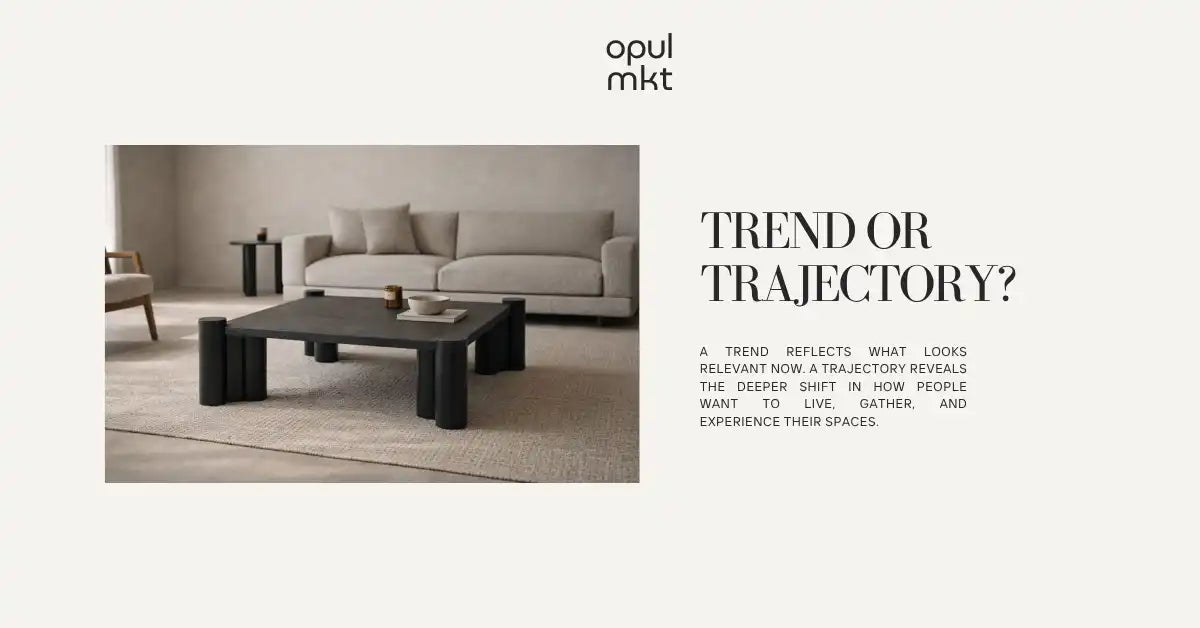
The interior design trend cycle is faster, louder, and more commercially amplified than it has ever been. A color appears across social feeds, a silhouette fills showrooms, and within months the look is treated as a visual shorthand for the moment. Yet a well-designed room is not a timestamp. It is an environment that must support daily life, hold personal meaning, and remain convincing after the algorithm has moved on.
The essential distinction is between a trend and a trajectory. A trend is a visible expression of changing taste; a trajectory is the deeper movement beneath it, often shaped by technology, material innovation, cultural behavior, or a renewed appreciation for craftsmanship. Understanding that difference makes it easier to identify pieces worth living with, build a home with coherence, and make confident decisions when a client asks whether something is genuinely enduring or simply fashionable.
This is not an argument for beige rooms or historical imitation. It is a method for reading design intelligently: separating fads from trends in interior design, recognizing personal preference, and investing in objects whose value extends beyond their immediate visual appeal.
Read the Movement Beneath the Look
What a trend actually signals
A trend is rarely meaningless. It may reveal a collective desire for softness after years of hard-edged minimalism, a return to ornament in response to digital sameness, or a hunger for natural materials in increasingly screen-based lives. The mistake is not noticing trends. The mistake is treating their most recognizable surface detail as the entire idea.
For example, the current appetite for rounded furniture may be less about one particular boucle sofa than about a broader preference for approachability, comfort, and informal social space. A hospitality client may express that trajectory through deeply upholstered lounge chairs, curved banquettes, and low tables with softened edges rather than by reproducing a single viral form in every room.
Trend, trajectory, and fad
A fad depends on immediate recognition. It often has a narrow palette, a highly repeatable shape, or a strong association with a particular online image. A trend has more staying power because it answers a real need. A trajectory lasts longest because it can evolve across materials, scales, and contexts.
- Fad: visually distinctive, quickly saturated, and difficult to adapt once its cultural moment passes.
- Trend: a broader shift in taste that can inform several design decisions over time.
- Trajectory: a durable movement grounded in how people want to live, work, gather, rest, or connect with materials.
Consider color. A very specific shade may be fashionable for a season, while the trajectory toward warmer, earth-derived palettes reflects a more enduring desire for rooms that feel grounded. The professional response is to use the precise color in a removable textile or artwork, then build the architectural and furniture foundation around tones that can accept change.
“The most confident interior does not predict the next look; it gives the next look somewhere intelligent to land.”
Why Some Rooms Feel Calm Long After the Trend Has Passed
The psychology of a calm home
The psychology of a calm home is not reducible to pale walls, empty surfaces, or a particular style label. Calm is produced by legibility: the eye understands how materials relate, circulation feels unforced, lighting is layered, and objects appear chosen rather than accumulated. A room can be richly colored and highly collected while still feeling quiet if its visual hierarchy is clear.
In a Houston living room, for instance, a large wool rug, a properly scaled sofa, two reading lamps, and a restrained grouping of art may create more composure than a sparse room filled with fashionable sculptural accessories. In a boutique hotel lobby, repeated natural stone and bronze details can establish continuity, while individually varied seating prevents the space from becoming institutional.
Coherence is not sameness
Enduring interiors usually contain tension: polished and tactile, old and new, restrained and expressive. Coherence comes from repeating a few underlying qualities rather than matching every finish. A walnut console, an aged bronze light fixture, and a dark wood frame can belong together because they share warmth and material depth, even if their forms come from different periods.
When bespoke furniture is specified, the goal should be more than a custom dimension. Proportion, edge treatment, joinery, and finish can be tuned to the room so the piece feels inevitable rather than decorative. That is one reason custom work often outlasts trend-driven replacements: it solves a spatial problem and develops a relationship to the architecture.
Finding Your Interior Design Style Without Choosing a Costume
Start with patterns, not labels
Finding your interior design style is more useful when it begins with recurring preferences rather than a quiz result. Review rooms, objects, and buildings you have saved. Look for patterns in scale, contrast, texture, and atmosphere. Do you respond to low horizontal furniture, strong vertical lines, irregular stone, glossy lacquer, or the patina of unfinished brass? These observations are more actionable than declaring an allegiance to “modern” or “traditional.”
A collector who repeatedly saves quiet rooms with one dramatic painting may not want minimalism; they may want a stable architectural envelope that gives art authority. A family renovating a suburban home may say they want classic modern home decor, but what they actually need could be durable upholstery, generous storage, and a few tailored details that keep the house from feeling overly formal.
Build a personal design brief
Before purchasing, write a short brief that describes how the room should feel and function. Include practical facts—children, pets, entertaining, natural light, maintenance tolerance—as well as emotional goals. “Warm, collected, and easy to reset after dinner” is a better direction than “timeless but interesting.”
Then identify three nonnegotiables and three areas where experimentation is welcome. In a bedroom, the nonnegotiables may be quiet lighting, a natural fiber rug, and concealed storage. Experimentation can happen in a bench fabric, bedside lamp, or artwork. This division prevents a temporary fascination from controlling the entire project.
Making Quality the Long-Term Variable
Buying furniture for life
Buying furniture for life does not mean every object must be heirloom furniture, nor does it require rejecting contemporary design. It means evaluating an object according to the conditions that determine whether it can remain useful: proportion, construction, repairability, material behavior, and the possibility of changing context.
For a dining table, inspect the thickness and stability of the top, the quality of the base connection, and whether the finish can be renewed. For an upholstered chair, ask about frame construction, suspension, foam density, cushion replacement, and the availability of fabric. A dramatic profile can be forgiven if these fundamentals are sound; a beautiful profile cannot compensate for a frame that loosens after two years.
Investing in quality furniture
Investing in quality furniture is often a question of total cost rather than initial price. A $1,800 chair replaced twice in five years can cost more than a $4,500 chair that is reupholstered and retained for fifteen years. The calculation also includes freight, installation, disposal, and the disruption of repeatedly redesigning a room around failed pieces.
For a developer furnishing a model residence, durable construction protects the presentation budget and reduces maintenance calls. For a private client, quality may be most valuable in high-contact pieces—a sofa, desk chair, bed, or dining table—while decorative experiments can remain lower-commitment. Opul Mkt’s trade program can be useful when a designer needs to evaluate specification, quantity, and project suitability across a larger installation.
- Solid wood: appropriate when repairability, tactile depth, and long service are priorities; expect natural movement and variation.
- Quality veneer: useful for dimensional stability and carefully matched grain across large panels; inspect substrate and edge construction.
- Natural stone: compelling for permanence and variation, but specify sealing, weight, and tolerance for etching.
- Performance textile: practical for hospitality and family spaces when tested for abrasion, cleaning, and colorfastness rather than selected by marketing language alone.
Designing a Foundation That Can Absorb Change
Put permanence in the right places
Enduring interior design depends partly on where you place risk. Floors, millwork, built-ins, major upholstery, and plumbing fixtures are expensive and disruptive to replace. Pillows, small tables, lampshades, art, and decorative objects can shift with far less consequence. A confident room concentrates investment in elements that establish comfort and proportion, then allows the more changeable layer to carry personality.
In a restaurant, the fixed layer might be a durable stone floor, banquette, and custom metalwork, while pendant shades or artwork provide refreshable identity. In an apartment entry, a well-made console and mirror can remain for decades, with the arrangement of vessels and books changing seasonally.
Use scale as the stabilizer
Scale is more enduring than finish. A properly sized rug can make a room feel resolved even when its pattern changes. In a seating area, at least the front legs of major chairs and sofas should generally sit on the rug; in a dining room, allow roughly 24 inches of rug beyond the table edge so chairs remain on the surface when pulled out. These are not rigid laws, but they explain why undersized accessories often make expensive rooms feel provisional.
Lighting deserves the same discipline. A chandelier selected only for its sculptural silhouette may date quickly or cast inadequate light. Specify the fixture according to ceiling height, table diameter, dimming compatibility, color temperature, and the visual weight of the room. Review UL or ETL listing and local electrical requirements before treating a decorative fixture as specification-ready. Browse indoor lighting by function and atmosphere, not only by trend category.
How to Avoid Trendy Decor Without Becoming Predictable
Use the three-question test
When considering a fashionable piece, ask three questions. Would I choose this if I had not seen it repeatedly online? Does it solve a spatial or functional need? Can I name at least two future settings in which it would still work? If the answer to all three is no, the object may be entertainment rather than design.
This does not mean every unusual item should be rejected. A collector may deliberately buy a flamboyant ceramic because it creates pleasure, not because it promises neutrality. The distinction is honesty. A purchase made as a temporary indulgence should not be presented as a foundational investment.
Common specification mistakes
- Choosing a finish from a small sample without viewing it in the room’s daylight and evening light.
- Copying a reference image without checking ceiling height, circulation, seat height, or door clearances.
- Using one viral material throughout a project, creating saturation rather than emphasis.
- Confusing visual simplicity with construction quality; a plain table can require more exacting joinery than an ornate one.
- Ignoring maintenance, especially for light upholstery, porous stone, unlacquered metal, and high-pile rugs.
A designer specifying a velvet sofa for a family room should test cleanability and abrasion, not simply admire the color. A hotel selecting a sculptural side table should confirm stability, load capacity, replacement lead time, and whether housekeeping can clean beneath it efficiently. Practical scrutiny is not an enemy of beauty; it protects beauty from premature failure.
Let Patina, Context, and Craft Create Longevity
Material aging as part of the design
Materials become enduring when their aging is legible and desirable. Walnut deepens, leather develops a sheen, bronze acquires variation, and wool can settle into a softer surface. By contrast, a fragile coating that chips unpredictably or a synthetic finish that cannot be repaired may make an object look tired rather than seasoned.
Ask the maker how a finish is intended to change. An unlacquered brass lamp in a private study may become more beautiful through handling, while the same finish in a hospitality setting may require a maintenance protocol. A silk rug can bring luminous depth to a low-traffic gallery-like room; a tightly woven wool rug may be the more intelligent choice for a busy family apartment.
Context is the antidote to generic timelessness
There is no universal timeless style. A 1920s apartment, a glass coastal house, and a mountain lodge each have different architectural truths. The strongest interiors acknowledge those truths while introducing objects from outside the period. A restrained contemporary sofa can sharpen historic molding; a hand-finished cabinet can give a new-build residence the sense of accumulated life.
For a hospitality project, regional context may appear through local craft, stone, or color rather than literal motifs. For a collector’s home, the trajectory may be a dialogue between works acquired over decades. This is why enduring interiors feel authored: they are responsive to place, not assembled from a timelessness package.
A Working Framework for Project Confidence
Separate the permanent, adaptable, and expressive layers
Before approving a scheme, classify every major decision. Permanent elements include architecture, flooring, millwork, and infrastructure. Adaptable elements include sofas, dining chairs, rugs, and case goods. Expressive elements include art, objects, accent lighting, and textiles. The classifications are not absolute, but they reveal where a bold decision carries real financial or spatial risk.
On a $150,000 living room project, a client might put the largest share into a custom sofa, a properly sized rug, and architectural lighting, then use a vivid side chair and unusual artwork to express current taste. If the chair eventually feels dated, the room does not require a complete reset. Confidence comes from making change affordable.
Specify with a five-year question
Ask how the room should perform five years from now, not whether it will still look exactly the same. Will the upholstery be serviceable? Can the lamp be rewired? Can the rug move to another room? Will the dining table accommodate a different apartment? Can a cabinet be refinished or repaired?
This approach supports commercial and hospitality projects as effectively as residential ones. It also creates a more intelligent sourcing conversation with makers and galleries. When provenance, materials, dimensions, and care requirements are documented, the buyer is not merely acquiring an image; they are acquiring a future.
FAQ
Look beyond repetition and ask what human need the idea addresses. If a form supports comfort, flexibility, better acoustics, or a renewed relationship with craft, it may belong to a broader trajectory. Check whether it appears across different materials and settings rather than only in one social-media image. Finally, test its adaptability: a lasting idea can be translated into upholstery, lighting, architecture, or objects without becoming a literal copy.
No. Timelessness is primarily about proportion, material quality, and a room’s ability to evolve. Strong color and pattern can be enduring when they are connected to the architecture, artwork, or the client’s genuine preferences. Use more commitment-intensive surfaces carefully, and place highly specific patterns in elements that can be reupholstered, moved, or replaced. A saturated wall or patterned rug can be more lasting than a neutral room assembled from disposable pieces.
Prioritize pieces that receive daily use and anchor the room: sofas, beds, dining tables, desks, and task chairs. Evaluate frame construction, joinery, suspension, cushion contents, finish, repair options, and warranty rather than relying on price alone. A quality side table or lamp can also justify investment if it is versatile and serviceable. Save on low-contact decorative items when needed, but avoid compromising on comfort, stability, and dimensions for foundational furniture.
Choose a size based on furniture relationships, not a catalog category. In a living room, the rug should usually connect the principal seating group, with at least front legs on the rug. In a dining room, allow approximately 24 inches beyond the tabletop on every side. For bedrooms, extending the rug beyond the sides and foot of the bed generally feels more generous. Always confirm door swings, vents, and transitions before ordering a custom or expensive rug.
Bespoke furniture is valuable when it resolves a difficult proportion, unusual dimension, material requirement, or functional need. A custom console that fits a narrow entry, a banquette shaped around a window, or a cabinet designed for specific collections can prevent compromises that would otherwise remain in the room for years. It is less compelling when customization is only a surface alteration. Request drawings, material samples, lead times, care instructions, and a clear approval process before commissioning.
Follow the maker’s instructions rather than applying a universal polish or cleaner. Protect wood from prolonged direct sunlight and moisture, blot spills on upholstery promptly, and use coasters or pads where appropriate. Rotate cushions, inspect hardware, and address loose joints or damaged finishes early. For rugs, use the correct pad, vacuum according to pile, and schedule professional cleaning based on traffic. Maintenance is most effective when it is preventive, not a response to visible failure.
Yes, if “classic” describes the discipline of the composition rather than a fixed period style. Begin with clear proportions, useful furniture, and a restrained material vocabulary, then add personality through art, collected objects, color, and meaningful irregularity. A contemporary room with a vintage cabinet, regional artwork, or an inherited chair often feels more personal than a room where every item was purchased as part of one coordinated collection.
Design for the Life Beyond the Moment
The distinction between trend and trajectory is ultimately a question of judgment. Trends can bring energy, relevance, and pleasure; trajectories offer the deeper structure that allows a room to remain useful and emotionally convincing. The best interiors do not reject the present. They edit it, placing current expression within a framework of proportion, craft, material intelligence, and personal meaning.
That is the foundation of enduring interior design: not a promise that nothing will change, but the confidence that change will be possible without starting over. When furniture is selected for comfort, repairability, and context, and when decorative decisions are made with proportion rather than pressure, a project gains both immediate character and long-term resilience.
Explore a More Considered Design Point of View
If you are developing a room, hospitality concept, or collection around pieces that can carry a project forward, explore the curated world of Opul Mkt. Browse living furniture, rugs, or wall art with the questions raised here in mind: How will this object age, what work will it do, and where might it belong next? For sourcing guidance or a more specific conversation, send a message to the Opul Mkt team and share the project, dimensions, and direction you are considering.


Leave a comment
This site is protected by hCaptcha and the hCaptcha Privacy Policy and Terms of Service apply.