

When simplicity is the luxury, restraint is not an absence of ideas; it is evidence of judgment. In interiors, the most convincing rooms rarely depend on a crowded vocabulary of finishes, an obvious logo, or a single dramatic gesture. They depend on proportion, tactility, light, and the confidence to let exceptional materials register quietly.
This approach matters now because clients are more visually literate and more skeptical of disposable style. A residential owner may want a room that feels collected rather than decorated. A hotel developer may need a lobby that remains relevant after the launch campaign has disappeared. In both cases, simplicity requires more specification—not less. This guide examines how to build quiet, highly resolved interiors through material quality, spatial editing, craftsmanship, and deliberate contrast.
The Discipline Behind Simplicity Is the Luxury
Restraint is an active design decision
Minimalism is often described as subtraction, but that definition is incomplete. The real work begins after unnecessary elements have been removed: the remaining pieces must carry greater visual, physical, and emotional weight. A plain oak table cannot hide behind ornament. A linen wallcovering must be judged by its weave, scale, and installation. A sculptural lamp has to be correctly positioned because there are fewer objects competing for attention.
Consider a city apartment with 10-foot ceilings, white oak floors, and generous natural light. Filling it with similarly pale furniture may create calm, but not necessarily character. A more exacting solution might pair one deep walnut cabinet with a low bouclé sofa, a hand-knotted wool rug, and a single work of photography. The palette remains quiet, while the differences in density, sheen, and silhouette create depth.
Luxury is felt in the ordinary
The strongest rooms also improve daily rituals. A drawer that closes with a controlled soft stop, a stone surface that feels warm and honed rather than glossy, or a reading chair with properly scaled arms contributes to a sense of ease that photographs cannot fully capture. This is why simplicity should be evaluated through use, not only appearance.
“The quieter the room, the more honestly it reveals the quality of every decision.”
In a boutique hotel lobby, that might mean a generous upholstered bench positioned near an outlet, a durable wool rug that absorbs sound, and lighting that transitions from daytime clarity to evening warmth. The luxury is not spectacle. It is the absence of friction.
Build the Room Around Proportion Before Product
The framework comes first
Before specifying a statement chair or pendant, establish the room’s spatial grammar. Measure circulation, sightlines, ceiling height, door swings, and the relationship between furniture and architecture. A simple object can feel expensive when its scale is exact; an expensive object can feel careless when it is undersized or stranded.
For a living room, begin with the conversation area rather than the shopping list. A sofa generally needs at least 30 to 36 inches of clear circulation behind or beside it, while a coffee table should sit approximately 16 to 18 inches from the seating edge for comfortable reach. In a larger room, a 9-by-12-foot rug may unify a seating arrangement more effectively than several small rugs that fragment the floor.
Two rooms, two applications
In a compact apartment, a 72-inch sofa, a 36-inch round table, and one appropriately scaled floor lamp may deliver more sophistication than a sectional, two accent chairs, and multiple side tables. The reduced inventory allows the architecture and the view to remain present.
In a hotel lounge, the same principle works at a larger scale. Rather than arranging every seat in a symmetrical grid, specify a few distinct settings: a high-backed pair for private conversation, a communal table for working, and low lounge seating around a substantial rug. The room feels edited, but it serves more behaviors.
Opul Mkt’s living collection is a useful starting point when the brief calls for foundational pieces with presence but without visual noise. The point is not to buy fewer objects indiscriminately; it is to select objects that perform more than one role—structurally, atmospherically, and socially.
Material Honesty Makes a Quiet Palette Convincing
Neutral does not mean uniform
A restrained palette becomes sophisticated when materials are allowed to differ. Pairing matte plaster with polished stone, nubby wool with smooth leather, or smoked glass with darkened metal creates a conversation that color alone cannot provide. The eye reads these variations slowly, which is precisely what gives a simple room staying power.
For a residence, compare a chalky limewash wall with rift-sawn oak cabinetry and a honed limestone hearth. All three may sit within a warm neutral range, yet each responds differently to light. In a restaurant, a similar strategy might use ribbed oak, saddle leather, and aged brass to make a compact dining room feel layered without adding pattern.
Choose finishes according to use
Material selection should also reflect maintenance and traffic. A hand-finished brass surface will develop a living patina, while a clear-coated brass finish will retain a more consistent appearance. Honed stone disguises fingerprints and small scratches better than high polish, but porous varieties may require sealing. Wool is resilient and naturally soil-resistant; silk offers luminosity and softness but is better reserved for lower-traffic areas or decorative panels.
- Wool: the practical choice for living rooms, corridors, and hospitality areas because it offers resilience, acoustic benefit, and visual depth.
- Silk: appropriate when sheen and delicacy are central, particularly in a formal sitting room or a low-traffic bedroom.
- Solid wood: valuable for tactile contact surfaces and pieces intended to be refinished over time.
- Veneer: often the more responsible and dimensionally stable choice for large panels, provided the substrate and edge treatment are properly specified.
For rugs, construction matters as much as color. A hand-knotted rug generally offers greater longevity and repairability than a hand-tufted design, while a flatweave can be ideal beneath a dining table because its low profile makes chairs easier to move. Explore rugs selected for varied interiors with construction, scale, and traffic in mind—not as an afterthought.
Let Craftsmanship Replace Ornament
Look for evidence at the point of touch
When a design is quiet, craftsmanship becomes the ornament. Examine how a wood grain turns across a cabinet door, whether a stone edge is crisp or over-rounded, and how upholstery meets a corner. On a chair, inspect the tension of the fabric, the joinery beneath the finish, and whether the proportions support the body rather than simply producing a pleasing silhouette.
A collector furnishing a study might choose a restrained writing desk with hand-cut dovetails and a natural oil finish instead of a more elaborate desk covered in applied decoration. The desk will reveal its quality every time a drawer opens. In a restaurant, a plain banquette can become a defining architectural element when its seam placement, foam density, and kick detail are resolved with precision.
Ask better sourcing questions
Professional buyers should request information before approving a piece. Ask where the material was sourced, how the finish is applied, whether replacement parts are available, and what can be repaired locally. For commercial furniture, review applicable ANSI/BIFMA documentation. For composite wood, verify CARB Phase 2 or TSCA Title VI compliance when relevant. For lighting, confirm UL or ETL listing, lamping, dimming compatibility, and the location of the driver or transformer.
These details are not bureaucratic distractions from design. They determine whether a quiet object will remain beautiful after years of use. A hospitality operator who specifies a fixture with inaccessible drivers may face unnecessary labor costs later; a homeowner who chooses a repairable solid-wood piece may preserve both value and material character for decades.
Use Lighting to Give Simplicity a Pulse
Layer illumination, even in a minimal room
A pared-back interior can become flat when lighting is treated as a single overhead solution. The most successful quiet spaces use layers: ambient light for general visibility, task light for activities, and accent light for artwork, architecture, or texture. Dimming and color temperature are equally important. A residential living room may benefit from warm sources around 2,700K, while a workspace may require a more neutral task light depending on the work performed.
In a gallery-like home, discreet wall washers can reveal a textured plaster wall while a table lamp creates intimacy at seating height. In a hotel lobby, concealed architectural lighting can establish a calm base, but decorative pendants over a reception desk provide orientation and a memorable focal point.
Specify the fixture as part of the architecture
Scale is critical. A pendant over a dining table should usually be large enough to relate to the table rather than hover like an accessory, while its bottom should preserve comfortable sightlines across the room. Wall sconces must be coordinated with millwork, artwork, and head height; placing them too high makes the room feel institutional, while placing them too low can create glare.
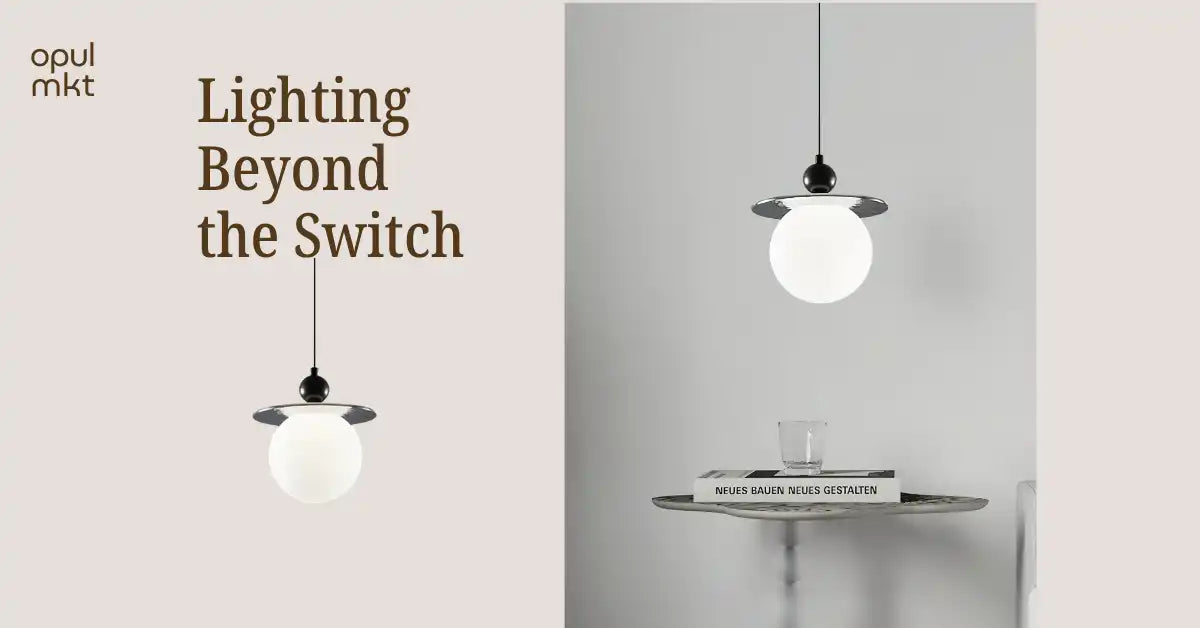
Opul Mkt’s indoor lighting collection can help organize the search by fixture type, from pendants to table lamps and sconces. The right choice is the one that supports the room’s use and material story, not simply the fixture with the most recognizable shape.
Contrast Keeps Quiet Interiors From Becoming Anonymous
Introduce one or two controlled surprises
Simplicity should never be confused with sameness. A room of uninterrupted beige, identical rounded forms, and uniformly soft finishes may be calm but can quickly become generic. Contrast supplies definition. It can come through scale, geometry, temperature, texture, or a single saturated note.
In a bedroom, a low upholstered bed might be balanced by a tall, narrow mirror and a dark stone bedside table. The contrast between horizontal softness and vertical reflection gives the room structure without adding clutter. In a corporate reception area, a restrained neutral envelope could support one large abstract painting, chosen for its composition rather than its ability to match the furniture.
Edit the statement piece
One strong work of art is often more effective than a wall of interchangeable decor. A sculptural vessel can carry more authority than a collection of small accessories if its silhouette is visible from the entry. Likewise, a substantial chandelier may be enough drama for a dining room; adding an ornate mirror, patterned rug, and elaborate drapery can dilute its effect.
Use the principle of visual hierarchy: identify what should be seen first, second, and third from the main approach. Opul Mkt’s wall art collection and sculpture collection offer ways to introduce personality without abandoning restraint. The question is not whether a piece is quiet, but whether it is necessary.
Specify for Longevity, Not Just the Reveal
Timelessness is a maintenance strategy
A timeless interior is not one that avoids every contemporary reference. It is one in which the expensive, difficult-to-replace elements have enough integrity to outlast fashion. Invest first in architecture, flooring, upholstery frames, lighting infrastructure, and storage. Refreshable layers—pillows, small tables, textiles, and accessories—can evolve without forcing a full renovation.
For a family room, performance upholstery may be the wiser luxury than a delicate fabric that requires constant restriction. For a vacation property, outdoor-rated materials, UV-stable finishes, and removable cushions can protect the design from climate rather than making maintenance an ongoing compromise. In either setting, ask how the piece will look after five years of honest use.
Document the specification
Keep a project record with dimensions, finish names, fabric contents, care instructions, lead times, and approved alternates. This is especially useful in commercial projects where replacement must be consistent, and in residential projects where a client may want to add matching pieces later. Confirm whether a finish is expected to patinate, whether a rug can be professionally cleaned, and whether replacement upholstery fabric remains available.
Trade professionals can also use Opul Mkt’s trade program when sourcing across a broader project, while bespoke services may be appropriate when standard dimensions or finishes do not serve the architecture. Customization is worthwhile when it solves a real spatial or performance problem—not simply because it is possible.
Common Missteps in the Pursuit of Quiet Luxury
When restraint becomes a formula
The first mistake is treating quiet luxury as a beige shopping list. A neutral color palette cannot compensate for poor proportions, weak lighting, or disposable construction. The second is overmatching: using the same wood tone, fabric texture, and rounded profile throughout a room removes the tension that makes simplicity engaging.
Another common error is buying statement objects before solving infrastructure. A beautiful pendant cannot correct a badly planned electrical layout, and an exceptional rug cannot fix furniture that is too small for the room. In a hotel, specifying visually delicate pieces without testing abrasion, cleanability, and replacement logistics can turn restraint into operational frustration.
A useful final review
- Can every major piece be explained by function, proportion, or emotional value?
- Are there at least three distinct tactile materials in the room?
- Does the lighting support morning, work, entertaining, and evening use?
- Have traffic, cleaning, repair, and replacement been considered?
- Is there one element with enough character to prevent the room from feeling anonymous?
If the answer is yes, the room will likely feel composed rather than sparse. The goal is not visual deprivation. It is to create enough space around the right things for their quality to be recognized.
FAQ
Not necessarily, but it often makes quality more visible. A room with fewer pieces may require better upholstery, more precise lighting, and stronger materials because there is nowhere for weak decisions to hide. Value comes from prioritization: invest in the sofa frame, flooring, lighting infrastructure, and high-touch surfaces, then use more modest accessories where they will not affect performance or longevity.
Layer texture, light, and natural material variation. Combine a matte wall finish with wood, wool, linen, leather, or stone, and use lamps at seating and eye level rather than relying only on recessed fixtures. Warmth also comes from scale: a generous rug, comfortable upholstery, and curtains with sufficient fullness can make a restrained palette feel enveloping without adding visual clutter.
Choose according to traffic and the desired hand. Hand-knotted wool is a strong general choice for living rooms and hospitality areas because it is durable, repairable, and richly dimensional. Silk or wool-silk blends provide greater sheen for formal, lower-traffic spaces. Hand-tufted rugs can offer expressive design at a lower cost, while flatweaves work well under dining tables or in high-clearance areas.
Whenever possible, select a rug large enough for the front legs of all major seating pieces to rest on it. A common starting point for a substantial seating group is 9 by 12 feet, though room dimensions should lead the decision. Leave a visible, intentional border of flooring around the rug rather than forcing it wall to wall, and preserve circulation paths around the arrangement.
Confirm the fixture’s UL or ETL listing, voltage, wattage, lamping, dimming compatibility, color temperature, and driver access. For a residence, coordinate the fixture with the control system and ceiling box before ordering. For a commercial project, review maintenance access, replacement parts, emergency requirements, and the installation conditions. A beautiful fixture is only successful when it can be operated and serviced reliably.
Look beyond the photograph. Inspect joinery, edge treatment, finish consistency, upholstery tension, hardware action, and the quality of concealed components. Ask for material specifications, care instructions, warranty terms, and repair options. A maker or dealer who can explain construction clearly is generally more trustworthy than one who relies only on a luxury description or a designer name.
Custom work is worthwhile when it resolves a meaningful constraint: an unusual wall length, a required storage capacity, a specific ergonomic need, or a finish that must coordinate with architecture. It is less valuable when it merely reproduces a standard form at greater expense. Request drawings, a finish sample, a realistic lead time, shipping terms, and a clear approval process before committing.
Keep permanent elements calm and let portable layers change. Art, cushions, tableware, small lighting, and decorative objects can introduce new color or cultural references without disrupting the room’s framework. This approach also supports repair and reuse: a well-made chair can be reupholstered, a wood table refinished, and a quality rug professionally cleaned rather than replaced whenever taste shifts.
Explore a More Considered Interior
Simplicity is the luxury when it is backed by discernment: exact proportions, honest materials, useful lighting, and craftsmanship that rewards attention over time. It is not a style that asks every room to look empty. It is a method for making space, money, and material count.
Begin with the element your project most needs—an anchoring rug, a sculptural light, a beautifully made case piece, or a work of art with enough presence to focus the room. Explore Opul Mkt’s curated collection, or browse decor and finishing pieces when the larger framework is already in place. For a specification conversation tailored to a residential, hospitality, or commercial brief, contact Opul Mkt and continue the process with the same principle that defines quiet luxury: choose deliberately, and choose well.



Leave a comment
This site is protected by hCaptcha and the hCaptcha Privacy Policy and Terms of Service apply.